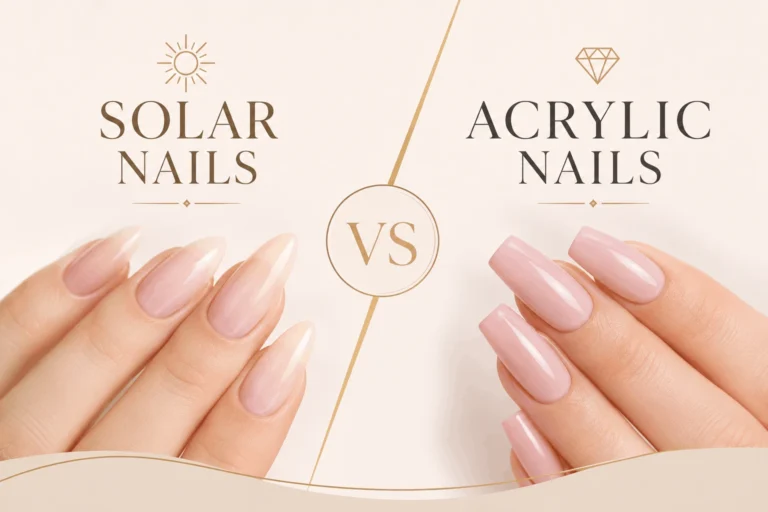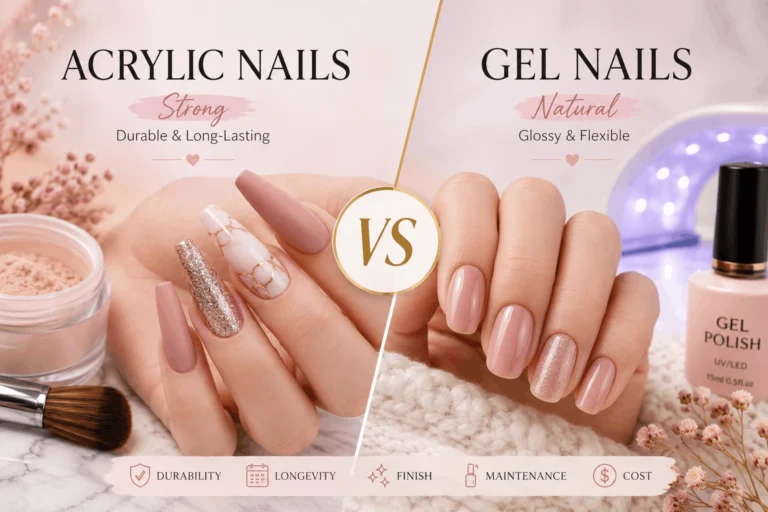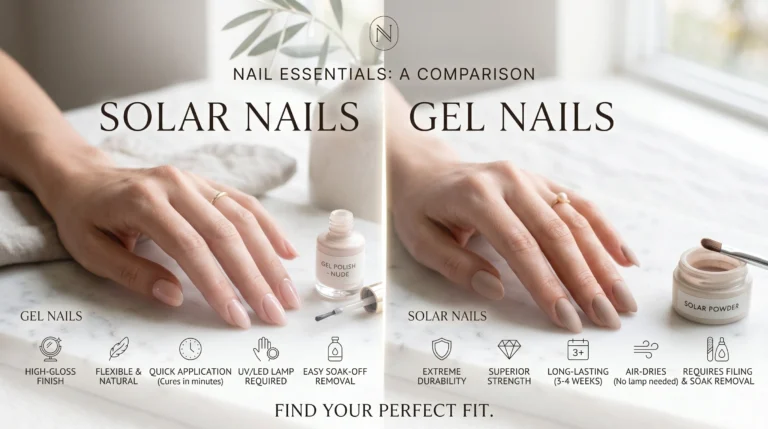
Solar Nails vs Dip Nails: Differences, Durability, Cost
Solar Nails vs Dip Nails:
The Complete 2026 Showdown
Solar nails vs dip nails — both are popular, both are durable, but they are very different systems. This complete guide compares solar nails vs dipping powder across durability, cost, removal, nail health, and which wins for your lifestyle in 2026.
Solar nails are a UV-stabilized acrylic system (no lamp needed) lasting 3–5 weeks — stronger, glossier, fill-based. Dip nails are a cyanoacrylate-bonded powder system requiring no lamp, lasting 3–4 weeks — lighter, more color options, easier removal. Solar wins on durability and shine; dip wins on odor, color choice, and nail health.
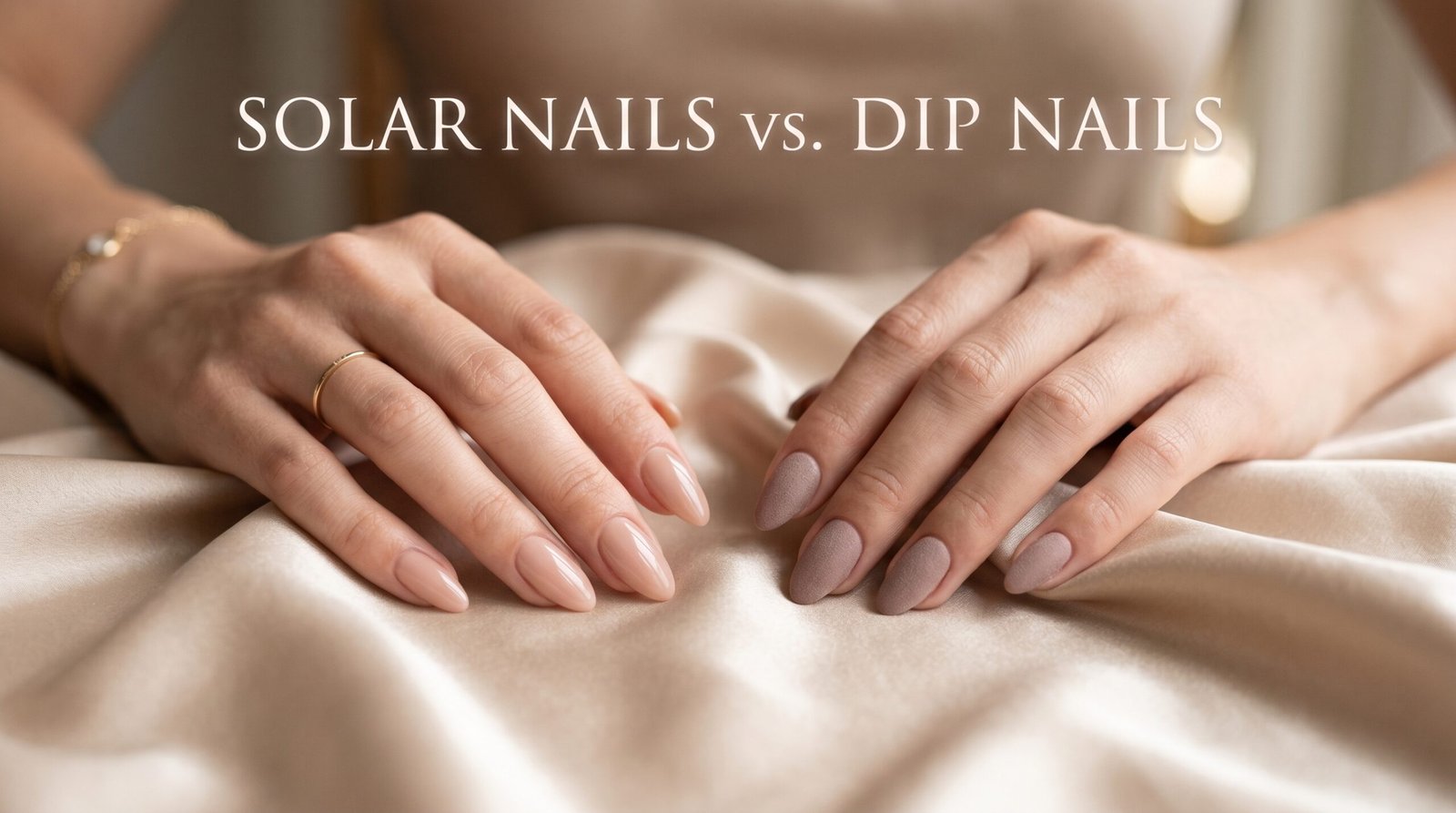
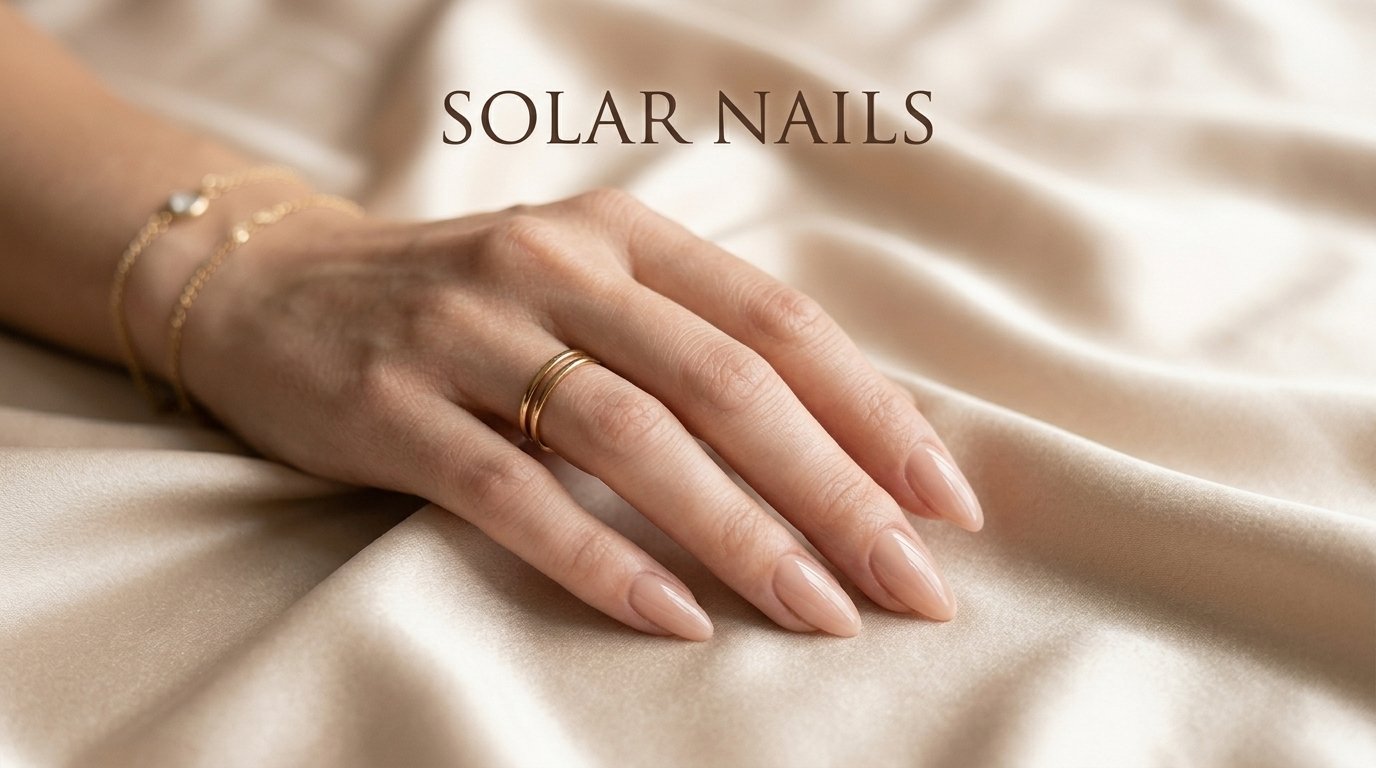
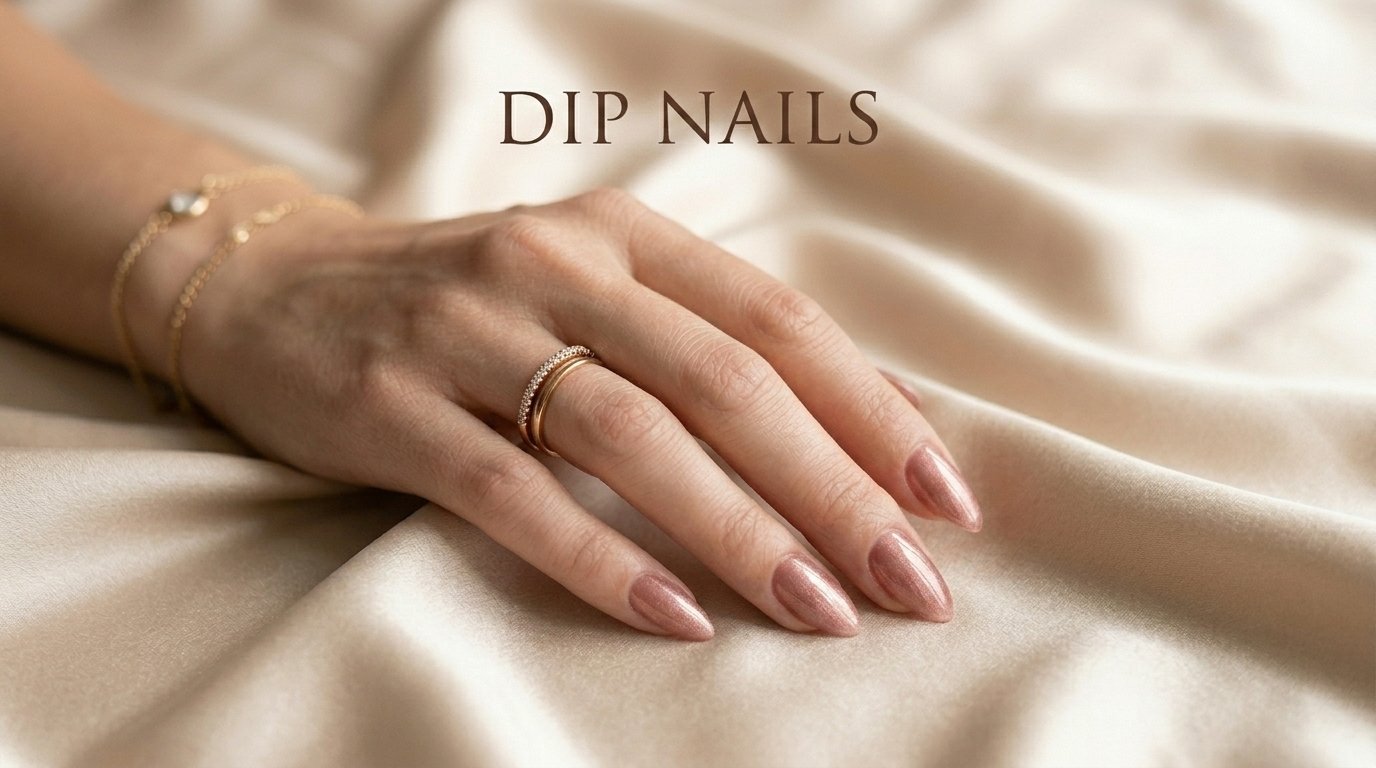
Solar nails are a UV-stabilized acrylic nail system originally developed by CND (Creative Nail Design), applied using a monomer-and-powder brush technique, and air-cured without a UV lamp. Dip powder nails (also called dipping nails, SNS nails, or dip nails) use a cyanoacrylate bonding agent and colored acrylic powder layered without a brush technique or UV lamp. Both are durable, no-lamp systems — but their chemistry, feel, durability, and maintenance schedules differ significantly.
What Are Solar Nails & Dip Powder Nails?
Before comparing them directly, it helps to understand exactly what each system is — because despite both being popular acrylic-based nail enhancements, they work very differently at the chemical and application level.
Solar Nails (Solar Powder)
A UV-stabilized acrylic nail system created by Creative Nail Design (CND) using ethyl methacrylate (EMA) powder and a liquid monomer. A nail technician uses a kolinsky brush dipped in monomer, picks up a bead of powder, and sculpts it directly onto the nail — where it air-cures (polymerizes) in 2–3 minutes without any UV or LED lamp. Solar nails are known for their exceptional gloss, impact resistance, fill-based maintenance, and UV/yellowing resistance. Often worn as a classic pink-and-white French manicure.
Dip Nails (Dipping Powder)
A layered powder nail system using a cyanoacrylate-based bonding liquid (similar to nail glue) as the adhesive, and a colored acrylic powder that is dipped, brushed, or poured onto each coat. No liquid monomer, no UV lamp, and no brush sculpting required — making the process faster and odor-free. Popular brands include SNS (Signature Nail Systems), OPI Powder Perfection, and Kiara Sky. Dip nails produce a lighter, thinner enhancement than solar acrylic with vibrant color options.
No — solar nails and dip nails are two different systems, despite both being acrylic-based and requiring no UV lamp. Solar nails use a liquid monomer and powder applied via a brush (traditional acrylic technique). Dip nails use a bonding agent and powder applied by dipping or pouring (no brush, no monomer). The similarity ends at “no UV lamp.” Their chemistry, durability, smell, application process, and maintenance schedules are quite different.
Solar Nails vs Dip Nails — 8 Key Differences
Here is a comprehensive breakdown of how solar nails compare to dip powder nails across every factor that matters to real clients choosing between the two:
Dip nails: Cyanoacrylate bonding agent + fine acrylic powder. Lighter bond, layered structure. Some brands (SNS) add calcium & vitamin E to their powder formula.
Dip: Apply bonding base coat, dip nail into powder, repeat layers, seal with activator & top coat. Faster and easier — some clients do it at home.
Dip: Solid but lighter than solar. Chip-resistant for 3–4 weeks under normal conditions. May crack under heavy impact. Solar wins on raw strength.
Dip: Smooth, even finish — slightly less glassy than solar unless a gel top coat is applied. Hundreds of colors including neons, glitters, mattes, and ombré.
Dip: Low odor — no liquid monomer used. The bonding agent has a mild smell only. Suitable for clients with odor sensitivities.
Dip: Hundreds of powder colors available — bold, pastel, glitter, chrome, thermal/color-change powders. Color is built into the material, not applied on top.
Dip: Typically requires full removal and reapplication each time. No fill service available with most dip systems — adds up in both cost and nail exposure over time.
Dip: File top coat, soak in acetone for 10–15 minutes. The powder dissolves faster than solar acrylic. Easier and quicker overall — a notable advantage for nail health.
Solar Nails — The Glossy, UV-Resistant Acrylic Finish That Lasts 3–5 Weeks
Solar nails win on: raw durability, gloss, fill-based maintenance (fewer total removal sessions), UV resistance, and impact resistance. Dip nails win on: odor, color variety, faster application, lighter feel, easier removal, and slightly better nail health scores. The right choice depends entirely on your lifestyle — not which is objectively “better.”
Solar Nails vs Dip Nails vs Gel Nails — Full Comparison Table
For context, here is how solar nails, dip powder nails, and gel nails compare across every factor that matters — the most comprehensive three-way comparison of these nail systems available:
| Feature | ☀️ Solar Nails | 💅 Dip Nails | 💎 Gel Nails |
|---|---|---|---|
| Product type | EMA acrylic (UV-stabilized) | Cyanoacrylate + acrylic powder | Polymer gel (UV-cured) |
| UV lamp needed? | No ✦Winner | No ✦Winner | Yes (UV/LED) |
| Durability | 3–5 weeks ✦Winner | 3–4 weeks | 2–3 weeks |
| Gloss / shine | Excellent (built-in) ✦Winner | Good (with top coat) | Excellent (mirror finish) |
| Color variety | Built-in + polish over | 500+ powder colors ✦Winner | Thousands of gel colors |
| UV resistance (no yellowing) | Excellent ✦Winner | Good | Moderate |
| Application odor | Strong (monomer) | Very low ✦Winner | Low–Medium |
| Feel on nail | Heavy, rigid | Light, natural ✦Winner | Light, flexible |
| Nail health impact | Moderate | Low–Moderate ✦ | Low ✦Winner |
| Fill maintenance | Yes — every 3–4 wks ✦Winner | No — full redo each time | Partial (gel polish: redo) |
| Removal ease | Medium (15–25 min acetone) | Easy (10–15 min acetone) ✦Winner | Easy (10–15 min) |
| Cost (USA full set) | $45–$70 | $35–$55 ✦Most affordable | $35–$65 |
| Annual visit frequency | ~13 visits/yr ✦Fewest | ~14–17 visits/yr | ~18–26 visits/yr |
| DIY friendly? | No (requires training) | Yes (beginner kits available) ✦Winner | Yes (gel polish kits) |
| Best for | Active lifestyles, French look, max durability | Color lovers, low-odor, DIY, color switchers | Natural feel, color variety, nail health |
✦ = advantage in that category. Industry averages; results vary by brand, salon, and individual nail condition.
Solar Nails: Pros & Cons
Before choosing solar nails over dip powder, here is an honest look at every advantage and limitation:
| ✅ Pros of Solar Nails | ❌ Cons of Solar Nails |
|---|---|
| Exceptional durability (3–5 weeks). The rigid EMA acrylic structure is impact-resistant, chip-proof, and ideal for physically demanding lifestyles — nursing, trades, athletics, gardening. | Strong chemical odor. Liquid monomer has a sharp, distinctive chemical smell. Not suitable for clients who are pregnant, sensitive to fumes, or working in scent-controlled environments. |
| Fill-based maintenance. Only the new nail growth needs attention every 3–4 weeks — the same set can be maintained for months. Far fewer full removal sessions per year compared to dip nails. | Heavier, rigid feel. Solar acrylic is noticeably thicker and stiffer than dip or gel nails. Clients transitioning from lightweight nails often need an adjustment period. |
| UV and yellowing resistant. The UV-stabilizing agents in the EMA formula prevent discoloration under sun exposure, tanning beds, or swimming — unlike standard dip or acrylic nails. | Longer removal process. Requires filing the surface and soaking in 100% acetone for 15–25 minutes. More time-consuming than dip nail removal. |
| Built-in French manicure gloss. The classic pink-and-white solar nail delivers a permanent, polish-free French look with a self-buffing mirror shine that stays weeks without fading or chipping. | Requires trained technician. The brush-and-bead sculpting technique takes years to master. DIY solar nails at home produce inferior results versus dip nails which are beginner-friendly. |
| Superior strength vs dip. Solar nails withstand more physical stress before cracking — making them the preferred choice for manual workers, athletes, and anyone whose hands take daily punishment. | Limited color variety in the acrylic itself. The pink/white solar formula has a narrow built-in color range. Additional colors require gel polish over the top — an extra step and cost. |
| Cost-efficient long-term. Despite a higher upfront cost, fewer salon visits per year (fills only vs full removal + redo) makes solar nails competitive in total annual spend. | Higher per-visit cost. Full sets start at $45–$70 in the USA — typically $10–$20 more than an equivalent dip powder set at the same salon. |
Dip Powder Nails: Pros & Cons
Dip nails have a devoted following for good reason — but they come with trade-offs that solar nail clients often overlook:
Dip Powder Nails — Lightweight, Vibrant, and Low-Odor
| ✅ Pros of Dip Nails | ❌ Cons of Dip Nails |
|---|---|
| Low odor. No liquid monomer means no sharp chemical smell during application — making dip nails far more comfortable in enclosed spaces, for pregnant clients, and in scent-sensitive workplaces. | No fill option. Unlike solar or acrylic nails, dip powder must be fully soaked off and reapplied at each appointment. This means more acetone exposure over time and higher total annual removal sessions. |
| Huge color selection. Dip powder is available in 500+ colors including neons, glitters, thermal color-change, ombre, and chrome finishes — a much wider in-material palette than solar acrylic systems. | Hygiene concerns at shared powder pots. If a salon dips multiple clients into the same powder jar, bacteria can transfer between clients. Always verify your salon pours into individual containers or uses brush-on application. |
| Lightweight, natural feel. Dip powder creates a thinner, lighter enhancement than solar acrylic — many clients describe it as the closest feeling to having no nail enhancements at all, while still lasting 3–4 weeks. | Less impact-resistant than solar. The layered powder structure, while solid, is more prone to cracking under heavy physical impact than the rigid solar acrylic system. Not ideal for manual laborers or athletes. |
| Faster application. A full dip nail set typically takes 45–60 minutes versus 60–90 minutes for solar nails. Fewer steps, faster drying, and a simpler technique means shorter salon visits. | Cyanoacrylate dehydration risk. The bonding agent (cyanoacrylate) can gradually dehydrate the nail plate over consecutive sets, especially if applied heavily. Monthly nail breaks help prevent long-term thinning. |
| DIY-friendly. Dip powder kits from OPI, Kiara Sky, and SNS allow relatively easy home application — something not feasible with solar acrylic’s brush-sculpting technique. Great for budget-conscious nail lovers. | Less UV resistant. Most dip powder formulas do not include the same UV-stabilizing agents found in solar acrylic. Extended outdoor exposure can cause dip nails to yellow or dull faster than solar nails. |
| Easier removal (10–15 min). The lighter powder formula dissolves faster in acetone than solar acrylic — reducing removal time by 10–15 minutes and lowering acetone exposure to the nail plate. | Higher long-term cost potential. Full removal + full redo every visit means 14–17 salon visits per year vs 13 fill-based visits for solar nails. Despite lower per-visit price, annual total costs can equalize. |
Yes — some salons and product brands offer “solar dip powder” or “solar dip nails”, which are dipping powder systems marketed with “solar” in the name to imply premium quality or UV-resistance. However, this is not the same as CND Solar nails (the original acrylic system). If you hear “solar dip nails” at a salon, ask whether they mean CND Solar acrylic or a dip powder product marketed as solar. The answer determines the whole experience.
Solar Nails vs Dip Nails: Which Is Better for Nail Health?
Nail health is often the deciding factor for clients comparing these two systems. Here is an honest, evidence-based breakdown of what each system does to your natural nails — and how to minimize damage with either choice:
Individual sessions are gentler with dip nails (faster removal, less odor, lighter structure). But over a full year, solar nails’ fill-based maintenance system means significantly fewer full removal cycles and cumulative chemical exposure. If you’re getting nails done consistently long-term, solar nails may actually be kinder to your nails despite the heavier per-session chemistry. The universal rule for both: never peel or forcibly remove either system — always soak, always hydrate, always take breaks.
Tips for Protecting Your Nails Under Either System
- Apply cuticle oil twice daily — regardless of whether you wear solar or dip nails.
- Schedule fills (solar) or full sets (dip) on time — overgrown enhancements create stress fractures at the nail bond.
- Give natural nails 2–4 weeks to rest every 3–6 months of continuous enhancement wear.
- For dip nails: insist your salon uses individual powder containers, not a shared jar.
- Never peel or forcibly remove either system — it physically strips nail surface layers.
- Wear rubber gloves during cleaning, dishwashing, or chemical exposure.
- Tell your technician immediately if you feel heat, burning, or see unusual lifting — these are early damage signals.
How Are Solar Nails and Dip Nails Applied?
Understanding the application process helps set expectations for your salon visit — and explains why solar nails require a trained technician while dip nails are DIY-friendly:
☀️ Solar Nail Application
- 1Nail Preparation
Clean, trim, and shape the natural nails. Push back cuticles gently. Lightly buff the nail surface to remove shine and improve adhesion. Apply a dehydrator only to the natural nail — never the tip.
- 2Apply Nail Tips (if extending)
Attach translucent nail tips trimmed to the desired length. File the seam between tip and natural nail smooth. For overlays, skip this step.
- 3Apply Primer
Apply acrylic primer to the natural nail bed only — this creates the chemical bond base that prevents lifting. Never apply primer to nail tips.
- 4Brush-and-Bead Sculpting
Dip a kolinsky brush in EMA monomer, wipe against the container edge, then dip into solar powder to form a bead. Apply the bead to the nail in one smooth stroke — first the pink zone, then the white tip. Shape carefully before the 2–3 minute air cure begins.
- 5Shape, Buff & Finish
Once cured, shape with a file, smooth the surface with a buffer, and apply a top coat, clear gel, or leave as-is for the natural solar shine. Application time: 60–90 minutes.
💅 Dip Nail Application
- 1Nail Preparation
Clean, trim, and lightly buff the natural nail. Apply a dehydrator to remove oils and moisture. Some systems use a pH bonder primer as well.
- 2Apply Base Coat (Bonding Agent)
Paint a thin layer of the cyanoacrylate-based bonding liquid onto the first nail. Do one nail at a time — the base coat must be wet when the nail contacts the powder.
- 3Dip into Powder
Immediately dip the nail into the colored powder at a 45-degree angle. Tap off excess. Repeat base coat + dip for 2–3 layers to build thickness. Each layer hardens within seconds.
- 4Apply Activator
Brush on the activator liquid, which reacts with the cyanoacrylate to fully harden and lock all powder layers. Wait 60 seconds — the nail will feel warm briefly as the chemical reaction occurs.
- 5Shape, Buff & Top Coat
File to desired shape, buff smooth, and apply the dip top coat for shine and protection. Application time: 45–60 minutes. At-home application possible with a kit.
Solar nails take 60–90 minutes for a full set (longer due to brush sculpting skill and cure time per section). Dip nails take 45–60 minutes — faster because each layer cures in seconds and no sculpting technique is required. For fills, solar nails take 30–45 minutes; dip nails have no fill service (full redo each time).
Solar Nails vs Dip Nails: Cost Comparison
Pricing varies by country, city, salon tier, nail design complexity, and technician experience. Here is a market-accurate breakdown across the most searched regions for this comparison:
Solar fills: $25–$40
Dip redo: $35–$55 each time
Solar fills: CA$30–$50
Dip designs: +CA$10–$25
Solar fills: £20–£35
Solar fills: AU$35–$55
At first glance, dip nails seem cheaper ($35–$55 vs $45–$70 per set). But the full picture changes when you count annual visits. Solar nails: ~4 full sets + 9 fills = approximately $275–$460/year in the USA. Dip nails: ~14–17 full sets per year = approximately $490–$935/year. Despite lower per-visit pricing, dip nails often cost significantly more annually due to full removal + redo at every appointment. Solar nails’ fill system is a genuine long-term cost advantage.
How to Remove Solar Nails and Dip Nails
Proper removal is critical for preserving natural nail health with both systems. Here is how each comes off — and what to do if you are removing at home:
Removing Solar Nails
File off the glossy top surface to break the seal, then soak in 100% acetone-soaked cotton wrapped in foil for 15–25 minutes. Gently push off softened acrylic with a cuticle pusher. Buff lightly and hydrate with cuticle oil. Time: 30–45 min. Professional removal recommended.
Removing Dip Nails
Lightly file off the top coat to break the seal, then soak cotton balls in 100% acetone, wrap in foil for 10–15 minutes. The powder softens and slides off in sections. Push off gently with a cuticle stick, buff smooth, and apply cuticle oil. Time: 20–30 min. More beginner-friendly than solar removal.
Step-by-Step: Safe Home Removal for Both Systems
- 1File the shiny surface
Use an 80–100 grit coarse file to buff away the entire glossy top layer. You do not need to file through the enhancement — just dull the surface so acetone can penetrate. This single step cuts soak time by 30–40%.
- 2Protect the surrounding skin
Apply a thin ring of petroleum jelly or thick cuticle oil around (not on) each nail to protect the skin from drying during acetone exposure. This is especially important for sensitive skin or dry cuticles.
- 3Soak cotton and wrap in foil
Saturate a cotton ball with 100% pure acetone (not nail polish remover). Press it against the nail surface and wrap tightly with a square of aluminum foil. Repeat for all ten nails. The foil seals in the acetone and prevents evaporation.
- 4Wait the appropriate time
Dip nails: 10–15 minutes. Solar nails: 15–25 minutes. Do not rush — under-soaked enhancement will not slide off cleanly, and forcing it will damage the nail surface. Rewarm wraps if acetone cools.
- 5Push off softened product
Remove one wrap at a time. The enhancement should feel soft and crumbly. Gently slide it off using a cuticle pusher with light, sweeping pressure. Never scrape hard. If resistant, rewrap that nail for 5 more minutes.
- 6Buff smooth and deeply hydrate
Use a 220-grit buffer to lightly smooth the nail surface in one direction. Apply cuticle oil generously to every nail and the surrounding skin. Follow with a thick hand cream. Your nails will feel temporarily soft — wait 24 hours before new enhancements.
Forcibly peeling solar nails or dip nails rips the top layers of your natural nail off with them — causing lasting thinning, surface pitting, and sensitivity that can take months to recover from. Patience with the acetone process is the single most important thing you can do for long-term nail health.
Ready to See Solar Nail Designs?
Browse our curated 2026 galleries of solar nail colors, French tips, chrome finishes, and seasonal art ideas.
Browse Solar Nail Designs Solar vs Gel NailsDip Nails vs Gel Nails: Is Gel Better Than Dip?
Your search data shows many visitors also want to know: “is gel better than dip?” and “what is the difference between gel and dip nails?” Here is the direct, authoritative answer:
Neither gel nor dip is universally “better” — each excels in different areas. Gel nails are better for nail health, natural feel, and detailed nail art. Dip nails are better for durability, low odor, color variety without a UV lamp, and cost. The “best” choice depends on whether you prioritize health (gel), color & durability (dip), or strength & longevity (solar).
| Factor | 💅 Dip Nails | 💎 Gel Nails |
|---|---|---|
| UV lamp needed | No ✦ | Yes (UV/LED lamp) |
| Durability | 3–4 weeks ✦ | 2–3 weeks (gel polish) |
| Nail health | Low–Moderate damage | Lowest damage ✦ |
| Color variety | 500+ powder shades ✦ | Thousands (gel polish) |
| Natural feel | Light, natural | Most natural feel ✦ |
| Odor | Very low ✦ | Low–Medium |
| Cost | $35–$55 ✦ | $35–$65 |
| Best for | Durability without UV, color variety, DIY | Nail health, natural feel, detailed nail art |
Dip nails are better than gel nails if you want longer wear without a UV lamp. Gel nails are better than dip if you want the most natural-feeling, nail-health-friendly enhancement. For maximum durability and gloss, solar nails outperform both. There is no single winner — it depends on your priority: health (gel), color & durability (dip), or strength (solar).
Who Should Choose Solar, Dip, or Gel Nails?
Based on everything covered above, here is your definitive decision guide for choosing the right nail system for your lifestyle, preferences, and nail health goals:
- You want maximum durability — 3–5 weeks with no chipping
- You work physically demanding jobs (trades, nursing, athletics)
- You love the classic French pink-and-white manicure look
- UV exposure concerns you (outdoor work, tanning, swimming)
- You want fill-based maintenance and fewer annual salon visits
- You prefer a permanent high-gloss finish without weekly top coats
- Long-term annual cost efficiency matters more than per-visit price
- You love changing nail colors frequently and want 500+ shade options
- Chemical odors are an issue (pregnancy, fume sensitivity, workplace rules)
- You want a lighter, more natural-feeling enhancement
- You are interested in DIY at-home nail application
- You prefer a lower per-visit upfront cost
- You want faster salon appointments (45–60 min vs 60–90 min)
- Your lifestyle is less physically demanding on your nails
- Natural nail health and minimal damage are your top priorities
- You love intricate nail art — detailed designs, gradients, line work
- You want a lightweight, flexible, barely-there feel on your nails
- You change your nail color every 2–3 weeks by choice
- You have fragile, thin, or damaged natural nails that need gentle treatment
- You are new to nail enhancements and want the easiest introduction
Yes — some salons offer a technique where solar acrylic is used for the structural base and extension, with dip powder applied over the top for color. This gives you the strength and durability of solar nails with the color flexibility of dip powder. Ask your nail technician specifically if they offer “solar base with dip color” as a service. It is not widely available at all salons but is gaining popularity.
FAQ — Solar Nails vs Dip Nails
Solar nails are an EMA acrylic system applied using a brush-and-monomer technique that air-cures in 2–3 minutes, lasting 3–5 weeks with fill-based maintenance. Dip nails use a cyanoacrylate bonding agent and colored powder layered without a brush technique, lasting 3–4 weeks but requiring full removal at each appointment. Solar nails are stronger, glossier, and UV-resistant; dip nails are lighter, more color-flexible, lower-odor, and beginner-friendly. Both systems require no UV lamp to cure.
Solar nails last longer than dip nails. A professionally applied solar nail set lasts 3–5 weeks before a fill is needed, while dip nails typically last 3–4 weeks before full removal and reapplication is required. Solar nails’ rigid EMA acrylic structure is more impact-resistant and chip-proof than dip powder’s layered cyanoacrylate construction, giving solar nails a durability advantage — especially in physically demanding conditions.
Solar nails are better than dip nails for durability, UV resistance, gloss, and long-term cost efficiency (fewer annual removal sessions). Dip nails are better for odor, color variety, lighter feel, easier removal, DIY application, and lower per-visit cost. Neither is universally superior — solar nails suit active lifestyles and French manicure lovers; dip nails suit color-focused clients who prefer odor-free, lightweight enhancements.
The key difference between gel and dip nails is the curing method and chemistry. Gel nails require a UV or LED lamp to cure — they use a polymer gel formula that hardens only under light. Dip nails require no UV lamp — they use a cyanoacrylate bonding agent and acrylic powder that air-cures. Gel nails are gentler on nail health and feel more natural. Dip nails last longer (3–4 weeks vs 2–3 weeks for gel polish) and require no lamp equipment.
Gel nails are better than dip nails for nail health, natural feel, and detailed nail art. Dip nails are better than gel for durability without a UV lamp, color variety, and lower odor. Gel polish lasts 2–3 weeks; dip powder lasts 3–4 weeks. If nail health is your priority, gel wins. If lamp-free durability and color variety matter most, dip wins. For maximum strength and longevity, solar nails outperform both gel and dip.
Dip nails are gentler per session — faster removal (10–15 min vs 15–25 min acetone soak), no harsh monomer odor, and a lighter structure. However, because dip nails require full removal and reapplication at every appointment (no fills), you accumulate more total acetone exposure and chemical contact per year than with solar nails’ fill-based system. Long-term, solar nails’ fewer annual removal cycles may actually reduce cumulative nail damage compared to regular dip powder redos.
Solar dip nails refers to two different things: (1) a hybrid technique where solar (EMA acrylic) is used as the structural base and dip powder is applied over the top for color — combining solar’s strength with dip’s color variety; or (2) a marketing term some dip powder brands use to imply premium UV-resistant qualities (similar to “solar” in solar nails). Always clarify with your salon whether they mean CND Solar acrylic or a dip powder product marketed as “solar.”
Solar nails cost $45–$70 for a full set in the USA (fills: $25–$40); dip nails cost $35–$55 per full set. While dip is cheaper per visit, solar nails use a fill system that reduces annual salon visits — resulting in approximately $275–$460/year for solar vs $490–$935/year for dip in the USA when calculated over 12 months. Despite lower per-visit pricing, dip nails often cost significantly more annually due to full removal and reapplication at every appointment.
Traditional dip powder systems do not offer fill services — the entire enhancement must be soaked off and reapplied from scratch at each appointment. Some advanced techniques exist where a skilled technician files down the grown-out dip powder and applies a new layer over the growth area, but this is not standard practice and can compromise adhesion and integrity. This is a significant disadvantage of dip nails vs solar nails, which support fill-based maintenance as a standard service.
Explore More Nail Guides
Complete comparisons, design galleries, and expert guides for every nail type.