Solar Nails vs Acrylic Nails: Key Differences, Pros & Cons
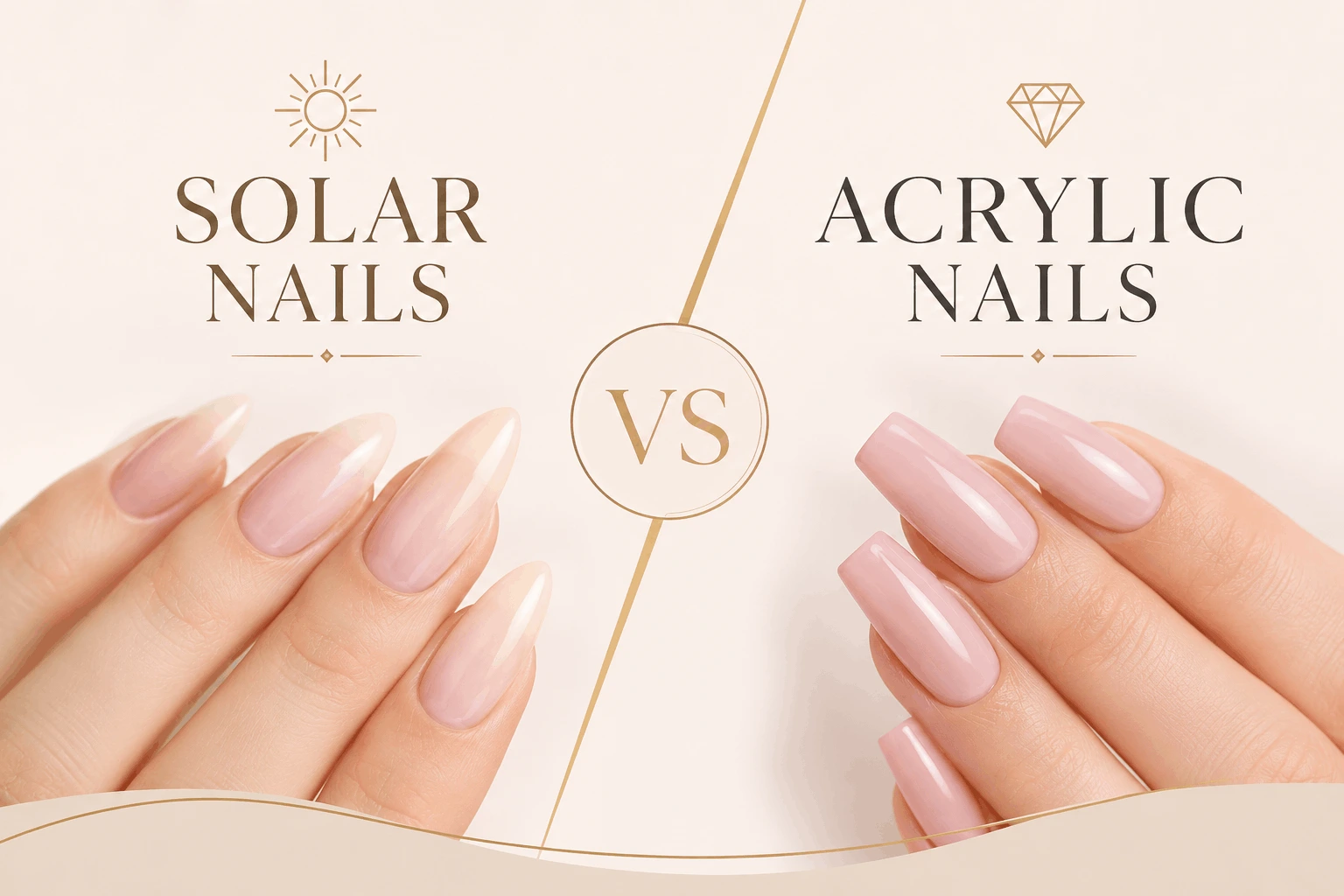
Solar Nails vs Acrylic Nails
Which Is Actually Better?
Durability, cost, maintenance, removal & nail health — everything you need to choose the right nail enhancement in 2026.
Written by the Solar Nail Design Expert Team
Our team of licensed nail technicians and beauty writers has tested and compared nail enhancement systems across professional salons since 2022.
Last updated: June 2026 · 12 min read · 3,400+ words
Solar nails are a premium CND-branded acrylic system that air-cures without a UV lamp, lasts 3–5 weeks, and resists yellowing from sunlight — making them more durable and lower-maintenance than standard acrylics. Acrylic nails use a generic monomer-polymer formula, cost less upfront ($30–60 vs. $45–70), need fills every 2–3 weeks, and offer far greater design versatility. Choose solar for longevity; choose acrylics for creativity and budget.
What Are Solar Nails? The Premium Acrylic System Explained
Solar nails are a specific professional-grade acrylic nail system developed by Creative Nail Design (CND), one of the most respected names in the professional nail industry. The word “solar” is not a generic nail type — it is a brand name attached to CND’s proprietary acrylic powder and liquid monomer formula.
What makes solar nails different from generic acrylics? Two key things: the chemical formula and the finish. Solar nails use ethyl methacrylate (EMA) as their primary monomer, which is considered safer and gentler on the natural nail than the methyl methacrylate (MMA) found in many budget acrylic products. The result is a harder, more chip-resistant nail that maintains a natural-looking gloss for significantly longer than standard acrylics.
Solar nails are not gel nails and do not require a UV or LED lamp to cure. They harden by air exposure alone. They are most commonly applied in a pink-and-white “permanent French manicure” finish — which is why you’ll hear them called “pink and white nails” or “permanent French nails” at many salons.
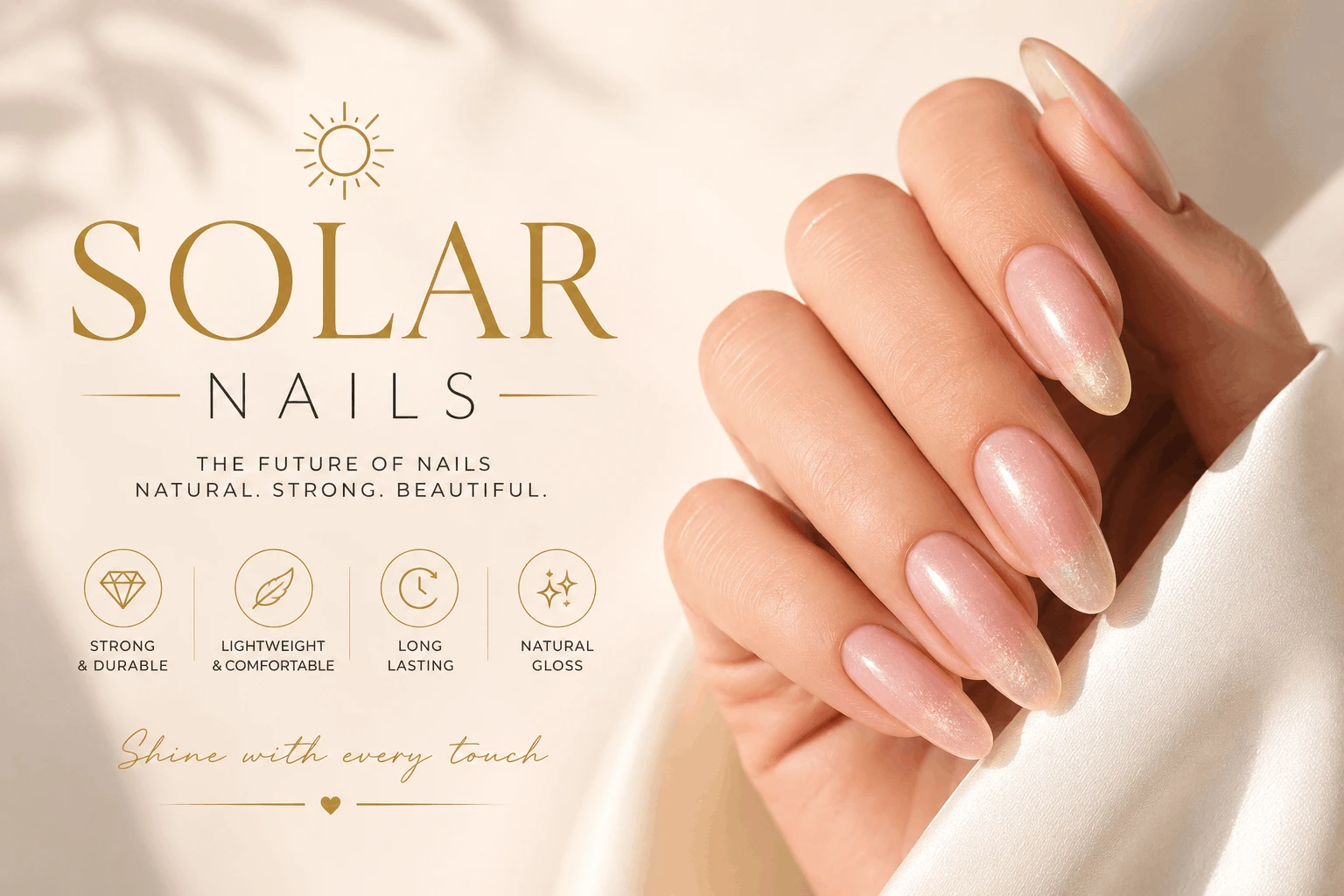
Key characteristics of solar nails:
- Air-cures without any UV/LED lamp
- UV-resistant — won’t yellow in sunlight or tanning beds
- Lasts 3–5 weeks between fills
- Made with EMA monomer (gentler formula)
- Natural glossy finish without top coat
- Classic “pink and white” (permanent French) aesthetic
- Applied directly over natural nail — no tip extensions required
- Repairable at home if a corner chips
- Not a gel product (no lamp curing)
- Not available as DIY kits under the CND brand
- Not interchangeable with every acrylic product
- Not suitable for extreme nail art as standard acrylics
- Not always cheaper upfront vs. budget acrylics
- Not available at every nail salon (requires CND products)
- Not identical to “solar gel” (a common marketing term)
What Are Acrylic Nails? The Salon Staple Demystified
Acrylic nails have been the foundation of professional nail enhancement for over four decades. They are artificial nail extensions created by combining a liquid monomer (typically ethyl methacrylate or, in cheaper products, methyl methacrylate) with a powder polymer. When combined and applied to the nail, this mixture hardens by exposure to air within 30–60 seconds.
Acrylic nails are the industry benchmark for nail extension technology. They can be applied as a full-coverage overlay on natural nails, extended with plastic tips for added length, or sculpted using nail forms to create custom shapes. Their incredible versatility — in shape, length, color, and embellishment — is the primary reason they remain the most popular nail enhancement type globally.
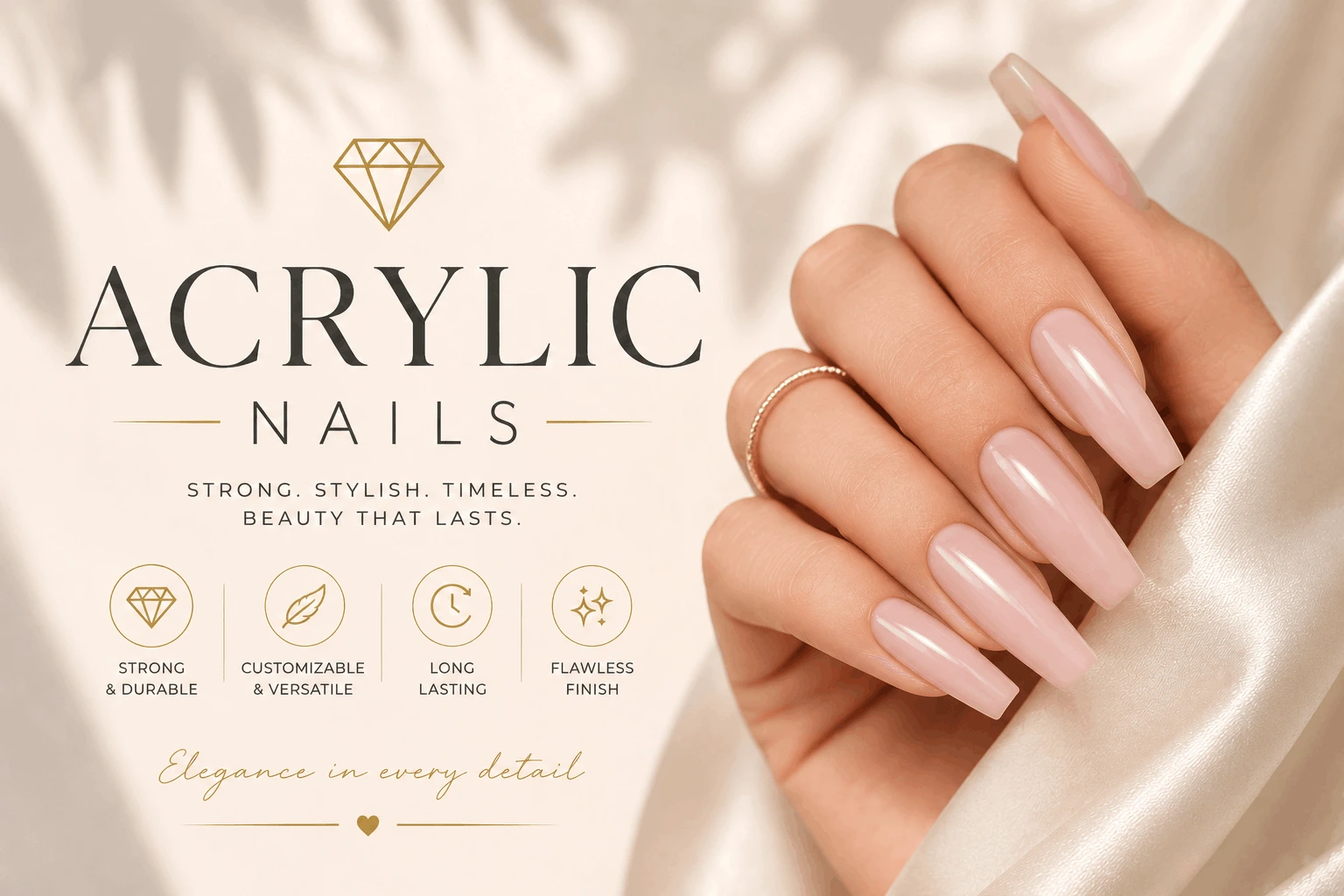
The quality of acrylic nails varies enormously depending on the product brand and the technician’s skill. High-quality salon acrylics using EMA monomers are far superior to cheap MMA-based products, which are banned in several US states due to safety concerns. Always ask your technician what monomer they use before booking.
How acrylic nails are typically applied:
Nail Preparation
Natural nails are cleaned, cuticles are pushed back, and the nail surface is lightly filed (etched) to improve adhesion.
Tip Application (if extending length)
Plastic nail tips are sized and glued to the natural nail edge, then blended with a file to remove the seam.
Primer Application
A dehydrator and/or primer is applied to the natural nail plate to maximize adhesion and prevent lifting.
Acrylic Application
The technician dips a brush in monomer, then into powder, creating a “bead” that is pressed and shaped onto each nail before it sets.
Shaping, Filing & Finishing
Once hardened, nails are shaped, buffed, and finished with gel top coat or polish for the final look.
Solar Nails vs Acrylic Nails: Complete Comparison Table
Here is a comprehensive side-by-side breakdown of every major factor that matters when choosing between solar nails and acrylic nails.
| Factor | ☀️ Solar Nails (CND) | 💅 Acrylic Nails | Winner |
|---|---|---|---|
| Durability | 3–5 weeks without fills | 2–3 weeks before noticeable growth/lifting | ☀️ Solar |
| UV Resistance | Will NOT yellow in sunlight or tanning beds | May yellow over time with UV exposure | ☀️ Solar |
| Upfront Cost (US) | $45–$70 full set | $30–$60 full set | 💅 Acrylic |
| Annual Cost* | ~10–13 salon visits/year | ~17–26 salon visits/year | ☀️ Solar |
| Lamp Required | No — air-cures naturally | No (some top coats use UV lamp) | ☀️ Solar |
| Finish Quality | Natural glass-like gloss (built-in) | Requires polish/top coat for gloss | ☀️ Solar |
| Design Versatility | Limited (best in classic/neutral styles) | Unlimited shapes, lengths, nail art options | 💅 Acrylic |
| Monomer Type | EMA (ethyl methacrylate) — safer formula | EMA (quality) or MMA (budget — avoid) | ☀️ Solar |
| Application Method | Applied directly to natural nail (overlay) | Tips glued on + acrylic overlay, or full sculpt | Tie |
| Maintenance Frequency | Every 3–5 weeks | Every 2–3 weeks | ☀️ Solar |
| Availability | Salons stocking CND products only | Available at virtually every nail salon | 💅 Acrylic |
| Removal | Acetone soak-off (may take longer) | Acetone soak-off (standard — 15–20 min) | 💅 Acrylic |
| Nail Health Risk | Lower (EMA formula, no tip glue) | Moderate (depends on product quality & tech skill) | ☀️ Solar |
| Best For | Low-maintenance, natural, active lifestyles | Bold designs, nail art, experimentation | Lifestyle-dependent |
*Annual cost estimate based on fill visits only. Prices vary by salon, location, and technician expertise.
Durability: Which Nail Enhancement Lasts Longer?
Durability is typically the deciding factor for most people comparing solar nails vs acrylic nails — and solar nails win here consistently. The CND solar formula creates a denser, harder acrylic bond than most generic acrylic products, resulting in a nail that resists chips, cracks, and lifting significantly better.
Solar nails durability ratings:
Top bar = Solar Nails | Bottom bar = Standard Acrylics | Ratings out of 10, based on professional technician assessments
Standard acrylic nails — especially those applied with lower-quality MMA monomers or by less experienced technicians — can begin lifting at the cuticle edge within 7–10 days. This lifting is not just cosmetic: it creates a pocket where moisture can accumulate, increasing the risk of bacterial or fungal growth beneath the nail.
Solar nails, by contrast, maintain their bond to the natural nail plate far more consistently. Their dense EMA formula does not shrink as dramatically as MMA during curing, which means less internal stress at the product-nail interface and significantly less lifting over time.
Solar nails are specifically formulated to be UV-resistant, meaning they hold their color and gloss even after beach days, outdoor activities, or tanning bed sessions. This is the single biggest physical advantage they hold over conventional acrylics, which can yellow noticeably after UV exposure.
Cost Breakdown: Solar Nails vs Acrylic Nails (2026 Prices)
Cost is one area where the picture is more nuanced than it first appears. Yes, solar nails cost more per appointment — but the math over a full year can actually favor solar nails when you account for fill frequency.
| Cost Item | ☀️ Solar Nails | 💅 Acrylic Nails |
|---|---|---|
| Full Set (US avg.) | $45–$70 | $30–$60 |
| Full Set (Canada avg.) | CAD $50–$80 | CAD $35–$65 |
| Fill / Infill | $30–$50 | $20–$40 |
| Fill Frequency | Every 3–5 weeks | Every 2–3 weeks |
| Fills Per Year (est.) | 10–13 fills | 17–26 fills |
| Est. Annual Fill Cost | $300–$650/year | $340–$1,040/year |
| Removal | $10–$25 (salon) | $10–$20 (salon) |
The takeaway: if you maintain your nails consistently, solar nails can cost less annually than keeping up with acrylic nails — despite the higher per-visit price. This is because solar nails need roughly half as many fill appointments per year.
If upfront cost is your primary concern, acrylic nails are the better choice. But if you calculate your total nail spend over 12 months, solar nails often win — especially if you were booking acrylic fills every 2 weeks (which many people do during fast nail-growth periods).
Maintenance: Which Nail Type Is Easier to Keep Up?
This is where solar nails pull ahead for busy people. Because of their denser bond and superior UV stability, solar nails require significantly fewer salon visits per year and hold their appearance between those visits better than acrylics.
Solar nail maintenance routine:
- → Apply cuticle oil daily (CND Solar Oil is the gold standard) to keep the cuticle area hydrated and prevent product lifting
- → Book fill appointments every 3–4 weeks once growth becomes visible at the cuticle
- → Wear rubber gloves during cleaning — prolonged exposure to harsh chemicals (bleach, acetone, dishwashing liquid) weakens any acrylic bond
- → Avoid using nails as tools (opening cans, scraping surfaces) — this stresses the product-nail junction
- → If a corner chips, a small home repair with nail glue and filing is possible — no full salon visit required for minor damage
Acrylic nail maintenance — what’s different:
Acrylic nails require fills every 2–3 weeks. The growth at the cuticle becomes more noticeable faster, and the risk of lifting increases significantly if appointments are delayed past 3 weeks. Any lifting must be addressed quickly, as moisture trapped beneath the nail product can cause a greenish bacterial discoloration (often mistaken for a fungus) called “greenie.” Polish on acrylics also chips faster, typically within 5–7 days without a gel top coat.
Application Process: How Solar Nails Are Applied vs Acrylics
Both nail types use acrylic chemistry, but the application process has some meaningful differences that affect both the experience and the outcome.
- Applied directly over the natural nail plate
- White powder applied to the free edge first
- Pink powder layered over the nail bed
- Mimics French manicure as default finish
- Air-cures — no UV lamp step
- Typically 60–90 minutes for a full set
- Requires CND-certified or trained technician
- Applied with or without tip extensions
- Clear, pink, or colored acrylic powder options
- Monomer liquid + powder applied in beads
- Can be sculpted on nail forms for custom length
- Air-cures (some UV gel top coats optional)
- Typically 45–90 minutes for a full set
- Available at virtually any nail salon
One practical implication: because solar nails are applied without pre-glued tip extensions, there’s no glue-to-nail-edge bond that can pop or snag. This reduces the risk of accidentally ripping off a nail — a painful experience common with poorly applied acrylic tips. The overlay-on-natural-nail approach of solar nails is inherently more secure for active people.
Appearance & Design Options: Natural vs Dramatic
This is the category where standard acrylic nails have a clear advantage — and the choice may come down entirely to your personal aesthetic.
What solar nails look like:
Solar nails are famous for their natural, high-gloss finish. The classic application — pink powder on the nail bed, white powder on the tip — creates a look that resembles a permanent, perfectly maintained French manicure. This finish doesn’t require regular polish changes to stay looking fresh, which is a huge selling point for people who want consistently polished nails without constant color updates.
While solar nails can be finished in any color, the design options are more limited than acrylics. You won’t typically get the same level of intricate 3D nail art, ombre blending, or sculptured dramatic length from a solar nail appointment.
What acrylic nails can do:
Acrylic nails are the canvas of professional nail art. From coffin-shaped stilettos to 3D embellishments, any length, any shape, any finish — acrylics make it possible. Want chrome powder nails? aura nails? Encapsulated florals? Acrylics are the go-to medium for experienced nail artists worldwide.
Choose solar nails for a clean, natural, always-polished look that needs minimal upkeep. Choose acrylic nails if you want bold, creative, statement-making nail art and the freedom to change your style at every appointment.
Nail Health & Safety: Which Type Is Better for Your Natural Nails?
Both solar nails and acrylic nails involve a degree of nail plate preparation (etching/buffing) that temporarily thins the natural nail. However, several factors make solar nails the safer long-term option for most people.
☀️ Solar Nail Health Pros
- EMA formula is gentler, less irritating to skin
- No MMA (the harmful monomer banned in many states)
- No tip glue, reducing nail plate stress
- Fewer salon visits = fewer prep/removal cycles
- Higher-grade products mean better quality control
⚠️ Solar Nail Health Cons
- Still requires etching/filing of natural nail
- Some people are sensitive to EMA monomer
- Strong bond can cause nail thinning on removal
- Professional removal always recommended
💅 Acrylic Nail Health Pros
- Quality EMA acrylics are safe when applied correctly
- Well-understood chemistry with decades of salon use
- Easier to find technicians experienced in removal
- Can be filled regularly, reducing full removal cycles
⚠️ Acrylic Nail Health Cons
- Cheap MMA acrylics used by some budget salons = high risk
- Tip glue adhesive creates additional stress point
- Lifting risk creates moisture traps (bacterial growth)
- More frequent prep cycles = more nail plate thinning
The single most important nail health factor for both types is the removal process. Picking, peeling, or forcibly removing either solar or acrylic nails can remove layers of the actual nail plate with them, leaving nails thin, soft, and prone to breakage for months. Always have enhancements professionally removed with proper acetone soak-off technique.
Removal Process: How Solar Nails and Acrylic Nails Are Removed
Removal of both types follows a similar acetone soak-off process, though solar nails typically require a slightly longer soak time due to their denser formula.
Professional removal steps (for both types):
File Down the Top Layer
The technician uses a coarse file or e-file to remove the top coat and bulk of the acrylic product, reducing soak time.
Acetone Soak
Cotton pads saturated in 100% acetone are placed on each nail and wrapped in foil. Standard acrylics soak for 15–20 minutes; solar nails may need 20–30 minutes.
Gentle Removal
Softened product is gently pushed off with an orangewood stick or cuticle pusher. If resistance is felt, more soaking is needed — never force.
Nail Plate Care
The natural nail is buffed smooth, then nourished with cuticle oil or a nail strengthener to begin recovery.
While it’s technically possible to remove solar or acrylic nails at home with acetone, foil, and patience, the risk of nail damage is significantly higher without a trained technician. If you must remove at home, never pry or force — only soak and gently push. Expect a longer process for solar nails (potentially 30–40 minutes of soaking) due to their superior bond strength.
Who Should Choose Solar Nails vs Acrylic Nails?
The “right” nail enhancement is the one that fits your lifestyle, budget, aesthetic goals, and how much time you realistically want to spend at the salon. Here’s a clear decision guide:
☀️ Choose Solar Nails If…
- You want nails that last 3–5 weeks between fills
- You spend time outdoors, sunbathe, or use tanning beds
- You prefer a natural, polished French manicure look
- You have a busy schedule and want fewer salon trips
- You want nails that won’t yellow over time
- Long-term cost savings matter to you
- You have sensitive skin or previous reactions to MMA
- You’re an active lifestyle person (gym, sports, outdoor activities)
- You want that “clean girl” aesthetic
💅 Choose Acrylic Nails If…
- You love changing nail art designs frequently
- You want dramatic length or extreme nail shapes
- Budget is your primary concern
- You want more salon options (acrylics are everywhere)
- You enjoy bold, creative, statement nails
- You like switching colors or art at each appointment
- You’re experimenting with nail enhancements for the first time
- Special events requiring custom nail art
- You prefer the flexibility of different product options
2026 Nail Trends: What’s Hot for Solar and Acrylic Nails
Both nail types have found their distinct place in 2026’s nail aesthetic landscape. Understanding the trend direction for each can help you decide which system better suits your style goals this year.
2026 Solar Nail Trends
Solar nails are dominating the “quiet luxury” and “clean girl aesthetic” nail conversations on TikTok and Instagram in 2026. The timeless pink-and-white solar finish has been reinterpreted in new directions:
- 🌸Sheer pink overlays — barely-there blush tones over the natural nail for an elevated nude look
- 🤍Milky white solar sets — opaque soft white that replaced the classic French tip among minimalist nail lovers
- ✨Glazed donut solar nails — the Hailey Bieber-inspired high-shine iridescent finish, now translated into solar overlay
- 🌙Café au lait solar sets — warm brown-pink tones blended in the classic solar two-tone format
2026 Acrylic Nail Trends
Acrylic nails continue to be the canvas for the most creative, expressive nail art of 2026. Current top trends include:
- 🌈Aura nails — soft gradient halo effects around the nail edges
- 🔮Chrome powder nails — mirror-finish metallic applied over gel top coat on acrylics
- 💎3D embellished nails — sculpted florals, pearls, and gems built up over acrylic base
- 🌊Mermaid nails — iridescent multi-tone scales using foils and chrome over acrylic
Frequently Asked Questions: Solar Nails vs Acrylic Nails
These are the most-searched questions about solar nails vs acrylic nails — answered with clear, expert-backed information.
Solar nails are a premium CND-branded acrylic system using ethyl methacrylate (EMA) that air-cures without a UV lamp, lasts 3–5 weeks, and won’t yellow from sunlight. Standard acrylic nails use a generic monomer-polymer formula, require fills every 2–3 weeks, and can yellow over time with UV exposure. Solar nails are more durable; acrylics offer more design freedom and are cheaper upfront.
Solar nails are better than acrylics in durability, UV resistance, gloss longevity, and long-term cost-effectiveness. However, acrylic nails are better for design flexibility, upfront budget, and salon availability. “Better” depends on your priorities: choose solar for low-maintenance longevity, choose acrylics for creative expression.
A full solar nail set costs $45–$70 in the US; a full acrylic set costs $30–$60. Fills for solar nails run $30–$50 every 3–5 weeks; acrylic fills cost $20–$40 every 2–3 weeks. Over a full year, the total spend on solar nails ($300–$650 in fills) is often less than maintaining acrylics ($340–$1,040), making solar nails the more cost-effective choice long-term.
Not more — and arguably less. Solar nails use EMA (ethyl methacrylate), which is gentler on the nail plate than the MMA monomers used in cheap acrylics. Solar nails also require fewer removal cycles per year (since they last longer), reducing cumulative nail plate thinning. The greatest risk of nail damage with either type comes from improper removal — picking or forcing off nails rather than acetone soak-off.
No — solar nails are specifically formulated to resist UV-induced yellowing. This is one of their most significant advantages over standard acrylics. If you spend time at the beach, outdoors, or in tanning beds, solar nails maintain their color and clarity far better than generic acrylic products, which can develop a yellow or orange tint from UV oxidation within weeks.
Solar nails last 3–5 weeks between fill appointments. Acrylic nails typically last 2–3 weeks before the growth at the cuticle becomes noticeable and lifting may begin. With excellent nail care (daily cuticle oil, gloves for housework, not using nails as tools), solar nails can extend comfortably to the 4–5 week end of their range.
Technically yes, but it’s not recommended. The correct method is: file down the surface, soak cotton pads in 100% acetone, wrap each finger in foil, and wait 20–30 minutes (longer than standard acrylics due to solar nails’ stronger bond). Then gently push off softened product — never pry or force. The risk of nail damage is substantially higher without professional technique. Salon removal costs $10–$25 and is always the safer choice.
Yes — “pink and white nails” and “permanent French nails” are common salon terms for the classic solar nail finish. The application uses CND pink powder over the nail bed and white powder over the tip, creating a built-in French manicure that never chips or needs repainting. This is the most popular solar nail style, though solar powder can also be applied in a wide range of colors.
Solar nails are the better choice for active lifestyles. Their superior durability, chip resistance, and UV resistance make them ideal for people who work out regularly, spend time outdoors, swim, or engage in hands-on activities. Standard acrylics are more prone to lifting and chipping under physical stress, especially in humid environments (pools, gyms). If you’re very active, solar nails will hold up significantly better between appointments.
Final Verdict: Solar Nails vs Acrylic Nails — Which Should You Choose?
After comparing every dimension — durability, cost, maintenance, appearance, nail health, and removal — here’s the honest verdict:
| Category | ☀️ Solar Wins | 💅 Acrylic Wins |
|---|---|---|
| Durability | ✓ 3–5 weeks | |
| Upfront Price | ✓ $30–60 | |
| Annual Cost | ✓ Fewer fills | |
| Design Options | ✓ Unlimited art | |
| UV Resistance | ✓ Won’t yellow | |
| Gloss Longevity | ✓ Built-in shine | |
| Salon Availability | ✓ Everywhere | |
| Nail Health | ✓ EMA formula | |
| Low Maintenance | ✓ Fewer visits | |
| Creative Freedom | ✓ Any shape/art |
If you prioritize durability, low-maintenance upkeep, UV resistance, and long-term value, solar nails are the superior choice. If you want maximum design freedom, lower upfront cost, and maximum salon availability, acrylic nails are the smarter pick.
The good news? You don’t have to commit forever. Try solar nails for a few months to experience the low-maintenance difference, then switch to acrylics when you want a bold new look for a special event. Both are valid, both can be stunning — it all comes down to what you want right now.
Ready to Explore More Nail Comparisons?
Dive deeper into the world of nail enhancements with our expert guides. Compare every major nail type and find your perfect match.