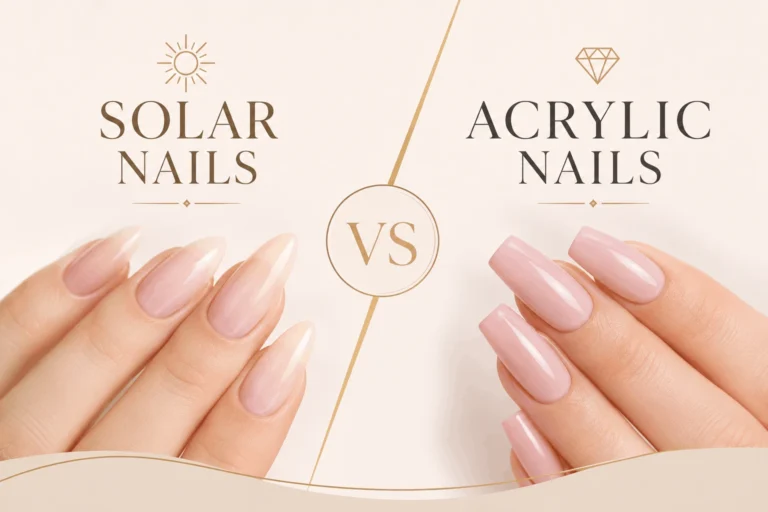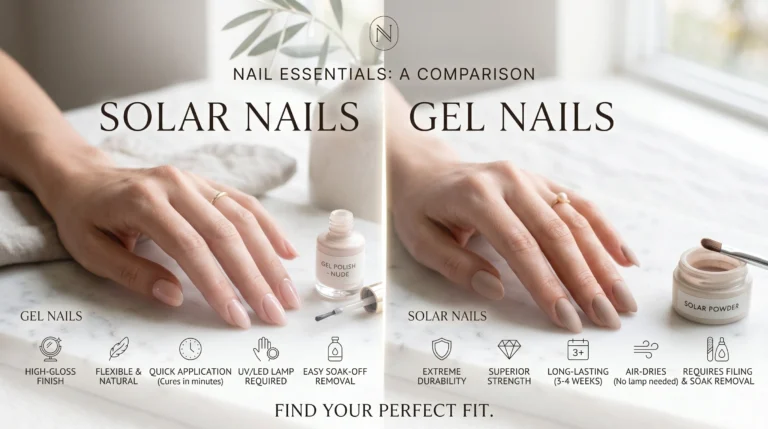
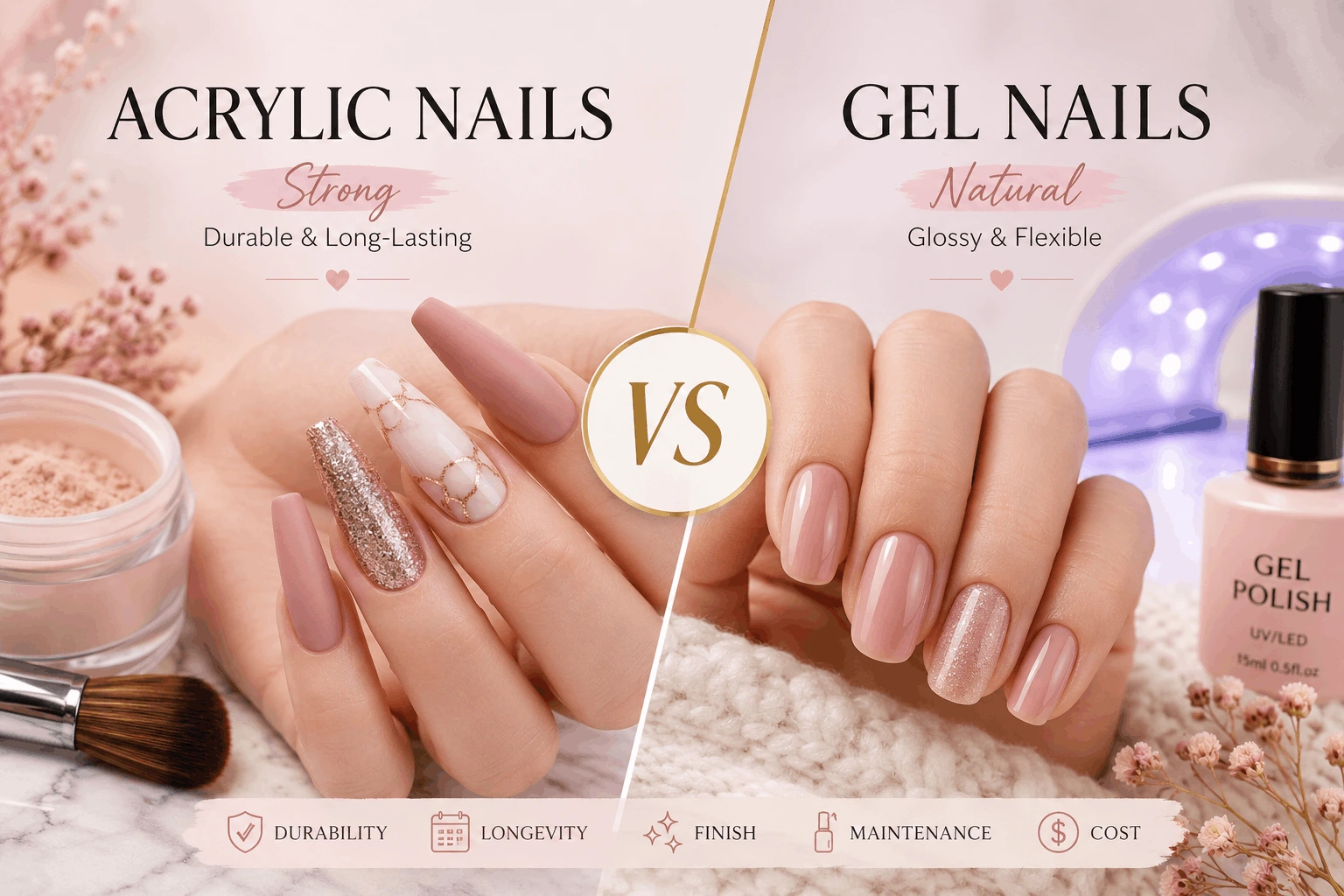
Acrylic Nails vs Gel Nails Key Differences | Pros & Cons
Acrylic Nails vs Gel Nails
Which Is Actually Better for You?
Application, durability, cost, nail health, UV safety, removal & the new PolyGel hybrid — everything you need to choose right in 2026.
Written by the Solar Nail Design Expert Team
Our licensed nail technicians and beauty writers have compared and tested nail enhancement systems across professional salons since 2022. Content reviewed against AAD manicure-safety guidance and FDA Nail Care Products guidance on HEMA and MMA.
Acrylic nails mix a liquid monomer with a powder polymer that air-cures into a hard, sculpt-able nail — best for extreme length, bold shapes, and maximum strength. Gel nails use a pre-mixed gel cured under a UV or LED lamp — best for a natural, flexible, lightweight look with a built-in gloss. Acrylics last longer with fills (3–4 weeks) and cost less upfront; gels are gentler on natural nails, odor-free, and look more natural. A new hybrid option — PolyGel — now offers the best of both worlds.
What Are Acrylic Nails? The Gold Standard of Nail Extensions
Acrylic nails have been the foundation of professional nail enhancement for over four decades — and they remain the most widely used nail extension system in salons worldwide. The chemistry is simple but powerful: a liquid monomer (typically ethyl methacrylate, or EMA) is combined on a brush with a powder polymer to form a pliable bead. This bead is pressed onto the natural nail and sculpted before it hardens through air exposure in 30–60 seconds.
That brief sculpting window is what makes acrylics genuinely unmatched for nail art, extreme lengths, and custom shapes. Whether you want floor-grazing stilettos or ultra-flat coffin nails, acrylics can deliver — and hold the shape under daily wear better than any other system.
Not all acrylics are created equal. High-quality EMA (ethyl methacrylate) acrylics used by reputable salons are safe and well-tested. However, cheap MMA (methyl methacrylate) products used by some budget salons can cause severe allergic reactions, nail damage, and are banned as a nail ingredient in several US states. Always ask your technician: “What monomer do you use?” before booking.
Acrylic nails — pros and cons at a glance:
✅ Pros of Acrylic Nails
- Maximum structural strength for long extensions
- Sculpt-able into any shape or length
- Ideal surface for 3D and intricate nail art
- Fillable — cuticle area topped up without full removal
- Available at virtually every nail salon globally
- No UV/LED lamp needed — air-cures naturally
- Lower upfront cost than gel nails
- Can last 3–4 weeks with consistent fill schedule
❌ Cons of Acrylic Nails
- Strong chemical smell from liquid monomer
- Heavier and stiffer feel than gel nails
- More aggressive nail prep required (deeper etching)
- MMA in cheap products is a serious health risk
- Prone to lifting if applied incorrectly
- Requires fills every 2–3 weeks
- Harder to remove — longer acetone soak
- Not DIY-friendly — high skill barrier
What Are Gel Nails? The Natural-Looking Modern Alternative
Gel nails are a nail enhancement system using a pre-mixed gel formula — a thick, viscous substance made from acrylate monomers — that is applied to the nail in thin layers and cured (hardened) under a UV or LED lamp. Unlike acrylics, there’s no mixing or sculpting window — the gel is applied directly from a pot or bottle and remains workable until the lamp is switched on.
The result is a nail that looks notably more natural, glossy, and lightweight than acrylics. Gel nails flex slightly with the natural nail rather than being rigid, which means they’re less likely to snap under impact — though they can lift from the nail surface over time if the prep or application isn’t perfect.
There are three main types of gel nails you’ll encounter at salons: soft gel polish (gel colour applied over natural nails), hard gel extensions (sculpted gel for adding length), and builder gel (a thicker gel used to strengthen natural nails or add modest extension). Each behaves differently in terms of durability, removal, and nail health.
Gel formulas often contain HEMA (hydroxyethyl methacrylate) — an ingredient that can cause contact allergies when it repeatedly touches the skin around the nail. Ensure your technician applies gel cleanly to the nail plate only, avoiding flood-the-cuticle application, and that each layer is fully cured under the correct lamp. Under-cured gel continues releasing monomers that sensitize skin over time.
Gel nails — pros and cons at a glance:
✅ Pros of Gel Nails
- Natural, lightweight feel — closest to a real nail
- Built-in high-gloss shine without top coat
- No strong chemical odor during application
- Less aggressive nail prep (thinner, less filing)
- Flexible — less prone to sudden snapping under impact
- Faster removal than acrylics (10–15 min acetone soak)
- DIY-friendly with at-home gel polish kits + LED lamp
- Excellent for natural nail length overlays
❌ Cons of Gel Nails
- Requires UV or LED lamp to cure (salon or at-home)
- Higher upfront cost than acrylics ($35–75 vs $30–60)
- Less structurally strong — can’t hold extreme lengths
- HEMA sensitization risk if applied incorrectly
- UV exposure during curing (minor but worth noting)
- Shorter wear time — 2–3 weeks before lifting
- Hard gel extensions can’t be easily filled like acrylics
- Peeling off gel causes serious natural nail damage
Acrylic Nails vs Gel Nails: Complete 2026 Comparison Table
Every major factor you need to make your decision — laid out clearly side by side.
| Factor | 💅 Acrylic Nails | ✨ Gel Nails | Winner |
|---|---|---|---|
| Durability (with fills) | 3–4 weeks | 2–3 weeks before lifting | 💅 Acrylic |
| Natural Look & Feel | Thicker, more rigid | Lighter, flexible, natural | ✨ Gel |
| Structural Strength | Superior for extensions | Moderate (hard gel only) | 💅 Acrylic |
| Odor During Application | Strong monomer smell | Virtually odor-free | ✨ Gel |
| Full Set Cost (US avg.) | $30–$60 | $35–$75 | 💅 Acrylic |
| Annual Cost (est.) | $400–500/year | ~$400–500/year | Tie |
| UV / LED Lamp Needed | No — air-cures | Yes — UV or LED lamp | 💅 Acrylic |
| Nail Health (prep) | More aggressive etching | Lighter filing, less prep | ✨ Gel |
| Removal Time | 20–40 min acetone soak | 10–15 min acetone soak | ✨ Gel |
| Design Versatility | 3D art, any shape/length | Great colour, natural art | 💅 Acrylic |
| DIY-Friendly | Difficult | Yes — gel polish kits | ✨ Gel |
| Extension Capability | Dramatic lengths possible | Moderate (hard gel) | 💅 Acrylic |
| Flexibility | Rigid — may snap under impact | Flexible — bends with nail | ✨ Gel |
| Salon Availability | Universal | Most salons (varies by type) | 💅 Acrylic |
| Built-in Gloss | Requires top coat / polish | Natural gloss after curing | ✨ Gel |
Application Process: Acrylic Nails vs Gel Nails Step by Step
The way each system is applied explains most of the differences in feel, durability, and nail health outcomes.
- Cuticles pushed back; nail surface etched with coarse file
- Dehydrator + primer applied to maximize bond
- Plastic tips glued on if extending length
- Monomer + polymer beaded on brush; applied to nail
- Tech shapes product during 30–60 sec pliable window
- Air-cures hard; then filed and shaped to perfection
- Finished with gel or regular top coat + polish
- Total time: 60–120 minutes
- Light buff of nail surface — less aggressive than acrylic prep
- Gel base coat applied; cured 30–60 sec under LED
- Gel colour applied in thin layers; each layer lamp-cured
- No monomer mixing — gel stays workable until lamp on
- Hard gel or builder gel added for extensions if needed
- Top coat applied; final cure under lamp
- Sticky inhibition layer wiped with cleanser
- Total time: 45–90 minutes
The critical practical difference: acrylics give the technician a narrow sculpting window of 30–60 seconds to shape each nail before the product locks hard. This precision requirement is why acrylic application takes real skill — and why salon quality varies so dramatically. Gel nails, by contrast, remain workable until cured, giving the technician unlimited time to perfect each nail before switching on the lamp.
Acrylic application — step by step:
Nail Prep
Cuticles pushed back, nail plate etched with a coarse file to create adhesion surface.
Tip Application
Plastic tips sized and glued to the free edge, then blended smooth for seamless extension.
Primer
Dehydrator and acid or acid-free primer applied to maximise bond and prevent lifting.
Acrylic Application
Monomer-loaded brush dipped in powder to create a bead; pressed and sculpted onto each nail.
Shape & Finish
Once hard, nails are filed, buffed smooth, and finished with gel top coat or polish.
Gel nail application — step by step:
Light Prep
Gentle buffing of nail surface — minimal etching compared to acrylic prep.
Base Coat + Cure
Gel base coat applied precisely to nail (not skin); cured 30–60 seconds under LED lamp.
Colour Layers + Cure
Thin gel colour layers applied and lamp-cured one at a time to build opacity.
Extensions (if needed)
Hard gel or builder gel built up over forms or tips for length; each layer cured.
Top Coat + Final Cure
Gel top coat applied, cured, and inhibition layer wiped clean for glass-like finish.
Durability: Which Nail Enhancement Actually Lasts Longer?
With consistent professional fills, acrylic nails last longer overall. A well-maintained acrylic set can theoretically last indefinitely — the technician fills the grown-out cuticle area every 2–3 weeks without removing the full set. Gel nails, by contrast, are generally replaced in full every 2–3 weeks because the gel cured in place can’t be as seamlessly filled at the cuticle.
There’s an important nuance here though: gel is more flexible than acrylic. This means gel nails are less likely to snap suddenly under impact — they bend slightly with the nail, distributing stress more evenly. Acrylics, being rigid, tend to fracture abruptly if they take a sharp knock, and when an acrylic breaks under impact, it can take nail plate layers with it. For active people who work with their hands, this is a real consideration.
Acrylics win on overall wear time (3–4 weeks with fills vs 2–3 weeks for gel). But gel’s flexibility means it survives accidental impacts better. If longevity matters most, choose acrylics. If you want nails that bend rather than break, gel is the smarter choice.
Cost Breakdown: Acrylic Nails vs Gel Nails (2026 US Prices)
The upfront price gap between acrylics and gel is real — but over a full year, the total spend evens out surprisingly quickly.
| Cost Item | 💅 Acrylic Nails | ✨ Gel Nails |
|---|---|---|
| Full Set (US) | $30–$60 | $35–$75 |
| Full Set (Canada) | CAD $35–$70 | CAD $40–$80 |
| Full Set (UK) | £30–£55 | £35–£65 |
| Fill / Maintenance | $20–$40 (fill every 2–3 wk) | $30–$50 (new set every 2–3 wk) |
| Appointments / Year | ~17–26 visits | ~17–26 visits |
| Est. Annual Cost | ~$400–$500/year | ~$450–$550/year |
| At-Home Option | $50–$100 (difficult) | $25–$60 (gel kit + LED lamp) |
| Removal (salon) | $10–$25 | $8–$20 |
Acrylics are cheaper upfront and fills ($20–$40) cost less than full gel replacements ($30–$50). Over a year, acrylics edge out gel on total spend by roughly $50–$100. However, the at-home gel polish route — where you apply gel polish yourself with a $25–$60 starter kit — dramatically reduces annual gel costs, making it the most budget-friendly option for colour and shine maintenance between salon visits.
Nail Health & Safety: Which Is Better for Your Natural Nails?
Both acrylics and gel nails involve some preparation of the natural nail, but the degree and chemistry differ significantly — and so do the long-term health implications.
What acrylics do to your natural nails:
Acrylic prep requires more aggressive nail plate etching — a coarse file is used to roughen the entire nail surface for adhesion. Repeated prep cycles over months thin the natural nail plate progressively. The strong liquid monomer (especially MMA in budget products) can also sensitize skin and cause contact allergies with cumulative exposure. Acrylics are also more rigid, so when a nail breaks under impact, it tends to tear away nail plate with it.
What gel nails do to your natural nails:
Gel prep is gentler — typically a light buff rather than deep etching. The product sits thinner on the nail. However, HEMA in gel formulas (particularly older or budget gel products) is a contact allergen when it touches the skin around the nail repeatedly. Ensure your technician applies gel cleanly to the nail plate only, and that each layer is fully cured under the correct matching lamp — under-cured gel continues releasing acrylate monomers onto the skin.
Never peel, pry, bite, or force off acrylic or gel nails. This is the single most damaging thing you can do to your natural nails — it removes entire layers of the nail plate, leaving nails thin, soft, and prone to breakage for months. Always insist on professional acetone soak-off removal, or follow the correct at-home soak-off technique.
Signs your nails need a break from both types:
- → Nails feel paper-thin, bendy, or weak without enhancement
- → White spots or visible surface damage on the natural nail
- → Persistent redness, swelling, or itching around the cuticle (see a dermatologist)
- → Lifting begins within just a few days of application
- → Green or dark discoloration under the product (consult a doctor — possible pseudomonas)
- → Nails have been continuously enhanced for 6+ months without a break
UV Lamp Safety: What the Science Actually Says About Gel Nail Curing
One concern that consistently comes up when comparing acrylic nails vs gel nails is the UV lamp required for gel curing. Here’s a clear-eyed look at what the research actually shows.
A 2023 study published in Nature Communications raised concerns about DNA damage from UV nail lamps — which sparked significant media coverage. However, the study used continuous exposure far exceeding what occurs in a typical gel appointment. In real-world salon use, the actual UV dose per appointment is very low — comparable to a few minutes of outdoor sun exposure.
The American Academy of Dermatology (AAD) acknowledges the low but non-zero UV risk from gel nail lamps and recommends: applying broad-spectrum SPF 30+ sunscreen to the hands before each gel appointment, or wearing fingerless UV-protective gloves with exposed fingertips during curing. Modern LED lamps emit lower UV levels than older UV-fluorescent lamps and cure gel significantly faster (30–60 seconds vs. 2+ minutes), reducing cumulative exposure per session.
LED vs UV lamp: what’s the difference?
- Emits targeted wavelengths for faster cure
- Cures gel in 30–60 seconds per layer
- Lower UV output — less cumulative exposure
- Energy-efficient and longer-lasting bulbs
- Only cures LED-compatible gel formulas
- Standard in most quality salons today
- Emits broad UV spectrum
- Cures gel in 2–3 minutes per layer
- Higher cumulative UV exposure per session
- Compatible with all UV gel formulas
- Bulbs need replacing every 6–12 months
- Being phased out by progressive salons
Appearance & Design Options: Bold Drama vs Natural Elegance
Your aesthetic is arguably the most important factor in this decision — and acrylic nails and gel nails serve genuinely different style communities.
What acrylic nails look like:
Acrylics are the canvas of professional nail art. Any shape — coffin, stiletto, almond, ballerina, squoval — is achievable and structurally sound. Any length, including dramatic floor-grazing extensions. The hard surface handles chrome powders, foils, 3D gel art, rhinestones, encapsulated flowers, and hand-painted designs without flexing or distorting the art. Coffin nails, 3D nail art, and almond nails are almost always built on an acrylic base.
What gel nails look like:
Gel nails have a naturally glossy, glass-like finish straight from the lamp — no top coat polish needed for shine. They look and feel noticeably closer to a healthy natural nail, which is why they dominate the “clean girl aesthetic” and quiet luxury nail trends of 2025–2026. Chrome powder effects, soft marble designs, metallic foils, and aura nail gradients all look stunning on a gel base. The gel’s natural flexibility also means the glossy finish moves beautifully with the nail rather than sitting stiffly on top.
Choose acrylics for bold, dramatic, statement nails with complex art or extreme lengths. Choose gel for a naturally elegant, glossy finish that looks polished without looking artificial — perfect for everyday wear, professional settings, and the understated luxury aesthetic dominating 2026 nail trends.
Removal Process: How Acrylic and Gel Nails Come Off
Both types are removed using acetone — but gel removal is faster and typically gentler than acrylic removal.
- File down bulk of acrylic product first
- Soak cotton pads in 100% acetone
- Foil-wrap each finger; wait 20–40 minutes
- Gently push off softened acrylic
- Re-soak if any resistance — never force
- Buff smooth; apply cuticle oil to recover
- Light file of top coat only (breaks seal)
- Soak cotton pads in 100% acetone
- Foil-wrap each finger; wait 10–15 minutes
- Gel dissolves faster than acrylic
- Gently push off residue with orangewood stick
- Buff and nourish with cuticle oil
Gel removal is typically 10–15 minutes with proper technique vs. 20–40 minutes for acrylics, which require more filing and a longer soak due to the denser product. This is one reason gel nails are considered less damaging overall — less time spent with the natural nail exposed to acetone and mechanical filing.
Maintenance & Aftercare: Keeping Both Looking Fresh
Whether you choose acrylics or gel nails, the same fundamental maintenance principles apply — and they make a surprisingly big difference to how long your nails look salon-fresh.
- → Apply cuticle oil daily — the single most effective maintenance habit. Hydrated cuticles = less lifting at the nail base for both acrylic and gel
- → Wear rubber gloves for washing up, cleaning, and gardening — prolonged water and chemical exposure softens the bond and accelerates lifting
- → Don’t use nails as tools — opening cans, scratching labels, and prying lids puts enormous shear stress on the product-nail junction
- → Moisturise hands daily — especially important with acrylics, which can dry the surrounding skin due to monomer chemistry
- → Avoid UV tanning beds with acrylic nails — prolonged UV causes some acrylic formulas to yellow over time (gel nails are less susceptible)
- → Address lifting immediately — a drop of nail glue stabilises minor lifts and prevents moisture from getting underneath
- → Take a 1–2 week break every 3–4 months — let natural nails breathe, recover, and strengthen between enhancement cycles
PolyGel Nails: The 2026 Hybrid That Changes the Game
If you’ve been reading this guide thinking “I want the strength of acrylics but the feel of gel” — there’s genuinely good news. PolyGel (also called AcryGel or hybrid gel) is a third option that has gained major traction since 2022 and is now widely available in quality salons in 2026.
PolyGel comes in a paste-like tube — it has the structure of acrylic (you can sculpt and shape it), but it doesn’t air-cure. Instead, it cures under a UV or LED lamp, giving you unlimited time to shape each nail before committing. The result is lighter than acrylic, more durable than standard gel, virtually odor-free, and significantly gentler on natural nails.
PolyGel was developed by Aprés Nail, Modelones, and Beetles, among others. It’s available at professional salons and as at-home kits. Brands like Aprés PolyGel, Modelones Poly Extension Gel, and Beetles Gel Nail Kit are among the most popular. PolyGel is typically priced between acrylics and gel extensions — around $45–$85 per full set in the US.
- Strongest structure
- Any length/shape
- Strong odor
- No lamp needed
- Cheapest upfront
- Strong & flexible
- Sculpt-able, lampable
- Odor-free
- LED lamp required
- Mid-range price
- Lightest, most natural
- Best for natural length
- Odor-free
- LED/UV lamp required
- Most expensive upfront
Salon Safety Checklist: What to Look For Before You Sit Down
The quality of your nail technician and salon environment matters more than which product you choose. Here’s what to check before your appointment.
✅ Salon Safety Checklist
- Tools are visibly sterilised (autoclave) or single-use between clients
- Technician washes hands or uses fresh gloves before your service
- Work surfaces are wiped with disinfectant between clients
- Salon has adequate ventilation — you shouldn’t smell overwhelming fumes
- Technician can tell you exactly which monomer/gel product they use (EMA, not MMA for acrylics)
- LED lamp is matched to the gel formula being used (wrong lamp = under-cure)
- Files and buffers are new or properly sanitised (not reused between clients)
- Cuticles are pushed back — not cut (cutting increases infection risk)
- No sharing of dip powder jars without individual pours (for salons offering dip)
- You’re given time to ask questions — a rushed technician is a red flag
Who Should Choose Which? The Honest 2026 Decision Guide
💅 Choose Acrylic Nails If…
- You want dramatic length or extreme nail extensions
- Bold nail art, 3D designs, or sculptured shapes are your thing
- Coffin, stiletto, or ballerina shapes are your go-to
- You need the strongest possible nail enhancement
- Budget is a priority — acrylics cost less upfront
- You’re okay with fills every 2–3 weeks
- Chemical odor doesn’t bother you
- You want a nail that can be filled, not fully replaced
✨ Choose Gel Nails If…
- You want a natural, lightweight, flexible feel
- You’re sensitive to strong chemical smells
- A built-in glossy finish matters to you
- You prefer shorter to medium natural nail lengths
- You want to try DIY nails at home (gel polish kits)
- You work in environments where odour is a concern
- You’re pregnant or chemically sensitive
- You want elegant, understated 2026 nail trends
2026 Nail Trends: What’s Hot for Acrylics and Gel
2026 Acrylic Nail Trends
- → 3D embellished nails — sculpted gel florals, baroque pearls and dimensional gems on acrylic bases are dominating 2026
- → Extra-long coffin revival — ultra-long coffin shape making a comeback, exclusively achievable on acrylic
- → Encapsulated art nails — dried flowers, foil shards, and glitters sealed inside clear acrylic for a “forever preserved” look
- → Chrome powder acrylics — mirror-finish metallics applied over gel top coat on shaped acrylic bases
2026 Gel Nail Trends
- → Glazed donut gel nails — Hailey Bieber’s signature high-shine sheer nude, dominating the “clean girl aesthetic” in gel format
- → Soft gel aura nails — pastel gradient halo effects that look stunning on gel’s naturally glossy surface
- → Matte gel finishes — velvet matte top coats giving gel nails a luxe suede effect for autumn 2026
- → Milk bath gel nails — sheer white-pink gel with suspended florals, the understated luxury manicure of 2026
FAQ — People Also Ask: Acrylic Nails vs Gel Nails
The most-searched questions about acrylic nails vs gel nails — answered with expert clarity for 2026.
Acrylic nails are made by combining a liquid monomer with a powder polymer that air-cures into a hard, sculpt-able nail — no lamp needed. Gel nails use a pre-mixed gel formula cured under a UV or LED lamp. Acrylics are stronger, cheaper upfront, and better for dramatic lengths. Gel nails are lighter, more flexible, odor-free, and look more natural. Both last 2–3 weeks without maintenance, with acrylics lasting longer with fills.
Acrylic nails last longer with consistent fills — up to 3–4 weeks between appointments, and indefinitely with a regular fill schedule. Gel nails typically last 2–3 weeks before lifting or chipping begins, and are generally replaced in full rather than filled. However, gel’s flexibility makes it more resistant to sudden breakage under impact compared to rigid acrylics.
Gel nails are generally considered less damaging to natural nails than acrylics — they require less aggressive filing during prep, are thinner, and remove faster with less mechanical stress. However, gel contains HEMA which can sensitize skin with repeated contact, and UV lamps carry a minor UV exposure risk. The biggest damage factor for both types is improper forceful removal — always use acetone soak-off, never peel or pry.
Acrylic full sets cost $30–$60 in the US; gel full sets cost $35–$75. Acrylic fills run $20–$40 every 2–3 weeks; gel maintenance is $30–$50 for a new set every 2–3 weeks. Annually, both cost roughly $400–$500 with consistent upkeep. Acrylics edge out gel on long-term savings by around $50–$100/year. At-home gel polish kits ($25–$60) can dramatically reduce gel maintenance costs.
The UV exposure from gel nail lamps is very low and generally considered safe for regular salon use. The AAD recommends applying broad-spectrum SPF 30+ sunscreen to hands before gel appointments as a precaution, or wearing UV-protective fingerless gloves during curing. Modern LED lamps emit lower UV levels than older UV fluorescent lamps and cure faster (30–60 seconds per layer vs. 2+ minutes), reducing per-session exposure. Clients with photosensitivity should always discuss UV precautions with their dermatologist.
Acrylic nails are better for dramatic 3D nail art, extreme shapes, and structural nail art that requires a rigid base. Chrome powders, foils, 3D gel embellishments, and hand-painted designs all perform beautifully on acrylics. Gel nails are better for smooth, natural, elegant designs — marble, chrome, soft ombré, and foil effects all look stunning on gel’s naturally glossy surface. For intricate sculptured art with jewels or dimensional elements, acrylics are the professional standard.
PolyGel (AcryGel) is a hybrid nail enhancement combining acrylic’s strength and sculpt-ability with gel’s lightweight feel and lamp-curing. It comes as a paste in a tube, is shaped using a slip solution, and cured under UV or LED. PolyGel is odor-free, lighter than acrylic, more durable than standard gel, and considered gentler on natural nails. It costs approximately $45–$85 per full set. PolyGel is widely considered the best “middle ground” option in 2026 for clients who want structure without acrylics’ downsides.
Yes — gel polish nails are very DIY-friendly. At-home gel polish starter kits (including a small LED lamp) are available from $25–$60 from brands like OPI Infinite Shine, Beetles, Modelones, and Harmony Gelish. Gel polish applied over natural nails is achievable with practice and produces genuinely salon-comparable results. Hard gel extensions at home are more difficult and require more product knowledge. Acrylic nails at home, by comparison, require mastering monomer ratios and sculpting technique — a significantly steeper learning curve.
Safe gel removal: (1) lightly file the top coat to break the seal; (2) place 100% acetone-soaked cotton pads on each nail; (3) wrap in foil for 10–15 minutes; (4) gently push off softened gel with an orangewood stick; (5) buff and nourish with cuticle oil. Never peel, bite, or force off gel nails — this strips natural nail plate layers and causes lasting damage. Professional salon removal costs $8–$20 and is always the safest option.
Final Verdict: Acrylic Nails vs Gel Nails — Which Should You Choose in 2026?
| Category | 💅 Acrylic Wins | ✨ Gel Wins |
|---|---|---|
| Durability (fills) | ✓ 3–4 weeks | |
| Natural Feel | ✓ Lighter, flexible | |
| Structural Strength | ✓ Extensions | |
| Odor | ✓ Odor-free | |
| Upfront Cost | ✓ $30–60 | |
| Nail Health (prep) | ✓ Less damage | |
| Design Versatility | ✓ 3D & sculpted art | |
| DIY-Friendly | ✓ Gel polish kits | |
| Salon Availability | ✓ Universal | |
| Removal Speed | ✓ 10–15 min soak | |
| No Lamp Needed | ✓ Air-cures | |
| Built-in Gloss | ✓ Natural gloss |
It’s genuinely six wins each — which tells you everything. There’s no universally better option. Acrylics win for strength, longevity, design, and budget. Gel wins for natural feel, nail health, odor, and easy DIY use.
If you’re still undecided, consider trying PolyGel — the 2026 hybrid that delivers acrylic-level strength with gel-level lightness and zero odor. Or, if you want the absolute premium option that lasts 3–5 weeks and never yellows, explore solar nails — CND’s professional-grade acrylic system that outperforms both standard acrylics and gel on durability.
Explore More Expert Nail Comparisons
Still weighing your options? Our complete comparison guides cover every nail type — from solar to dip to press-on.