Dip Nails vs Gel Nails: Your Perfect Long-Lasting Manicure!
Dip Nails vs Gel Nails
Which Should You Choose?
Durability, cost, nail health, removal, Shellac, Builder Gel, SNS hygiene — every factor compared by professional nail technicians so you can decide with total confidence.

Written by the Solar Nail Design Expert Team
Our licensed nail technicians have applied and compared dip and gel systems across thousands of salon appointments since 2022, including SNS, Shellac, BIAB builder gel, and hard gel extensions.
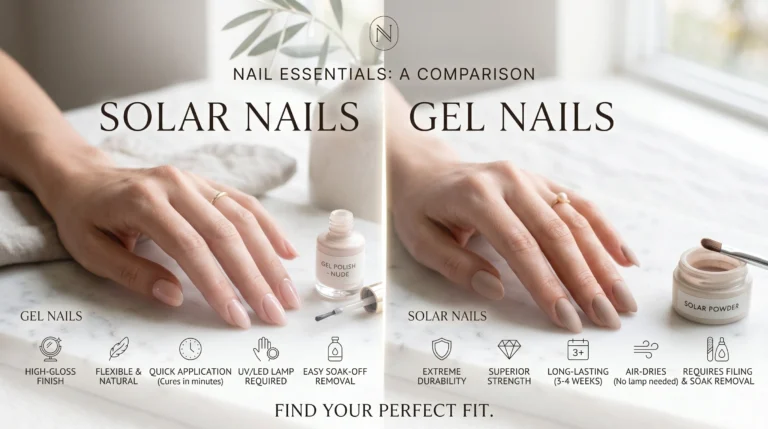
Dip nails (dip powder / SNS) layer colored acrylic powder over a cyanoacrylate base — no UV lamp, lasts 3–5 weeks, thicker and highly chip-resistant. Gel nails use gel polish cured under UV or LED — lasts 2–3 weeks, lighter, more natural-looking, and better for detailed nail art. Dip wins on durability and annual cost; gel wins on natural feel, design versatility, and DIY ease. In 2026, Builder Gel (BIAB) is the rising third option combining both worlds.
What Are Dip Nails? The Long-Lasting, No-Lamp Manicure
Dip powder nails — also called SNS nails, dip manicures, or powder dip nails — are a nail enhancement built by layering finely milled colored acrylic powder over a cyanoacrylate-based base coat. No UV or LED lamp is needed. The layers harden through a chemical reaction triggered by an activator solution.
The result: a thick, dense, glass-hard finish that consistently outlasts gel, regular polish, and even many acrylic applications. Dip nails are loved by busy clients who want gorgeous, chip-resistant colour without a bi-weekly salon schedule.
Despite the name, many modern salons no longer dip fingers directly into shared powder jars — a hygiene concern. Progressive salons pour or sprinkle powder in individual portions. Always ask how your salon applies dip powder before booking. See our SNS Hygiene section below.
✅ Pros of Dip Nails
- Lasts 3–5 weeks — longest colour system
- No UV or LED lamp required
- Highly chip-resistant, dense finish
- Virtually odor-free application
- Rich, vibrant, opaque colour payoff
- Matte, glitter & shimmer finishes available
- DIY-achievable with at-home kits
- Lower annual salon visit frequency
❌ Cons of Dip Nails
- Thicker, heavier feel vs. gel
- Shared jar hygiene risk at some salons
- Longer acetone removal (15–25 min)
- Less suited to intricate fine nail art
- Cyanoacrylate can cause reactions
- No fill option — full new set each time
- Can look bulky if over-layered
What Are Gel Nails? Shellac, Builder Gel & Soft Gel Explained
“Gel nails” covers several distinct products that share one trait: they cure under a UV or LED lamp. Understanding the types helps you pick the right one for your nails.
Applied like regular polish, cured 30–60 sec per layer. Lasts 2–3 weeks. Shellac (CND) is a brand of this type. Best for natural nails & DIY use.
Acetone Soak-OffThick self-leveling gel for strengthening natural nails. Lasts 3–4 weeks. Must be filed off. Best for weak or damaged nails in 2026.
File-Off OnlyYes — completely. Shellac is a brand of gel polish made by CND (Creative Nail Design). The application, LED curing, and removal are identical to standard gel polish. “Shellac nails” simply means gel polish done with CND’s formula. The terms are fully interchangeable.
✅ Pros of Gel Nails
- Natural, lightweight, flexible feel
- Glass-like built-in gloss after curing
- Virtually odor-free application
- Excellent for fine nail art & detailed designs
- Builder gel strengthens fragile nails
- Faster removal — 10–15 min (soft gel)
- Easiest DIY option (gel polish kits)
❌ Cons of Gel Nails
- Requires UV or LED lamp to cure
- Shorter wear — 2–3 weeks before lifting
- Higher per-set cost than dip
- HEMA sensitization risk if applied to skin
- Minor UV exposure during curing
- Hard gel must be filed, not soaked off
- Peeling causes severe natural nail damage
Complete 2026 Comparison Table
Every factor that matters — clearly scored side by side.
| Factor | ✨ Dip Powder | 💜 Gel Nails | Winner |
|---|---|---|---|
| Durability | 3–5 weeks | 2–3 weeks | ✨ Dip |
| Natural Feel | Thicker & heavier | Lighter & flexible | 💜 Gel |
| UV Lamp | Not needed | UV or LED required | ✨ Dip |
| Full Set Cost | $35–$60 | $30–$55 | 💜 Gel |
| Annual Cost | Fewer visits/year | More frequent visits | ✨ Dip |
| Nail Art | Solid colours, ombré | Fine art, chrome, gradients | 💜 Gel |
| Chip Resistance | Excellent | Good | ✨ Dip |
| Built-in Gloss | Good (top coat) | Glass-like shine | 💜 Gel |
| Application Time | 30–50 min | 25–50 min | Tie |
| Removal Time | 15–25 min | 10–15 min | 💜 Gel |
| Odor | None | None | Tie |
| Colour Vibrancy | Rich & opaque | Good (2–3 coats) | ✨ Dip |
| DIY Ease | Achievable | Very easy (kits) | 💜 Gel |
| Flexibility | Less flexible | Soft gel bends naturally | 💜 Gel |
Durability Deep-Dive: Scores & What They Really Mean
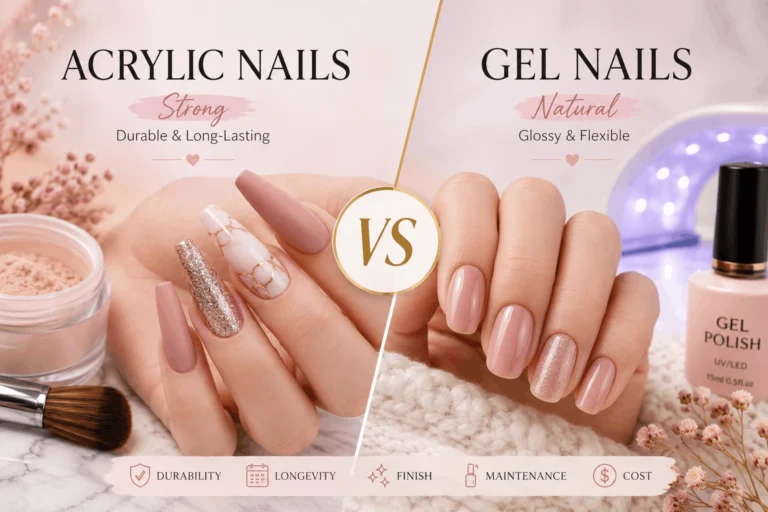
On raw wear time, dip nails win decisively. The denser polymer bond resists chipping and lifting significantly better than gel’s thinner cured layers — and with good nail care, dip can comfortably reach the 4–5 week end of its range.
Dip nails last 3–5 weeks vs 2–3 weeks for gel — a significant advantage for busy clients. The only gel system that rivals dip durability is Builder Gel (BIAB), which can stretch 3–4 weeks. See the Builder Gel section below.
Cost Breakdown: Dip Nails vs Gel Nails (2026 Prices)
Per-appointment prices are similar — but the frequency difference makes dip significantly more affordable over a full year.
| Cost Item | ✨ Dip Nails | 💜 Gel Nails |
|---|---|---|
| Full Set (US) | $35–$60 | $30–$55 |
| Full Set (Canada) | CAD $40–$65 | CAD $35–$60 |
| Full Set (UK) | £35–£55 | £28–£50 |
| Visits / Year (est.) | 10–17 visits | 17–26 visits |
| Annual Cost (fills) | $420–$700/year | $510–$1,100+/year |
| At-Home Kit | $30–$60 | $25–$60 (+ LED lamp) |
| Removal (salon) | $10–$20 | $8–$18 |
Gel polish looks cheaper at $30–$55/set but the 17–26 annual visits rack up fast. Dip’s fewer annual appointments (10–17) save $200–$400/year for regular salon clients. The cheapest option overall? At-home gel polish with an LED kit — achievable results from just $25–$60 total investment.
Application Process: Step-by-Step for Both
- Light nail buff — minimal prep
- Bond/dehydrator applied
- Cyanoacrylate base coat brushed on
- Powder dipped or poured over nail
- Base + powder repeated 2–3 times
- Activator applied — chemical cure
- File smooth, seal with top coat
- Very gentle nail surface buff
- Gel base coat applied to nail plate
- Cured 30–60 sec under LED lamp
- Colour coats applied & cured (2–3×)
- Gel top coat applied + final cure
- Inhibition layer wiped with cleanser
- Glass-like finish — no polish needed
Dip powder — step-by-step detail:
Nail Prep
Light buff of the nail surface — significantly less aggressive than acrylic prep. Cuticles pushed back gently.
Base Coat
Cyanoacrylate-based base applied to each nail — the adhesive layer that makes the powder bond.
Powder Application
Nail dipped or powder poured over. Excess tapped off. Repeated 2–3 times to build opacity and strength.
Activator
Activator solution triggers chemical hardening of all powder layers simultaneously.
File, Shape & Top Coat
Nails filed smooth to remove rough edges, sealed with top coat for lasting gloss.
Gel polish — step-by-step detail:
Gentle Prep
The lightest prep of any nail enhancement — a very gentle surface buff only.
Base Coat + Cure
Gel base coat brushed cleanly to the nail plate (not skin). Cured 30–60 seconds under LED lamp.
Colour Layers + Cure
Thin gel colour coats applied and cured one at a time. Usually 2–3 layers for full opacity.
Top Coat + Final Cure
Gel top coat cured, inhibition layer wiped clean — glass-like high-gloss finish revealed.
Nail Health & Safety: Which Is Kinder to Your Nails?
Both systems are far gentler than acrylics — but they each carry specific health considerations competitors rarely cover fully.
Dip nails and natural nail health:
The cyanoacrylate bonding in dip is safe for most people, but those with adhesive sensitivities may react. The activator can dry the skin around the nail with repeated use. The main risk: dip’s thicker profile creates more leverage if a nail catches — it may peel natural nail plate with it more readily than thin gel.
Gel nails and natural nail health:
Gel prep is the gentlest of any enhancement — a light buff only. However, gel formulas often contain HEMA (hydroxyethyl methacrylate), a contact allergen that sensitizes skin with repeated exposure to the cuticle area. Ensure your technician applies gel to the nail plate only, and that each layer is fully cured under the correct matching lamp — under-cured gel continues releasing sensitizing monomers.
Never peel, pry, bite, or force off dip or gel nails. This is the single most damaging action — it physically removes layers of your natural nail plate with the product, leaving nails thin and damaged for months. Always use proper acetone soak-off. Always.
Signs your nails need a break:
- → Nails feel paper-thin or peel in layers without enhancement on them
- → Persistent redness, itching, or swelling around the cuticle — see a dermatologist
- → Enhancement lifts within 3–5 days of application
- → Green or dark discolouration under product — see a doctor immediately
- → Continuous enhancement for 9+ months without any rest period
Appearance & Design: Bold Colour vs Natural Glass Gloss
Dip nails deliver rich, opaque, boldly pigmented colour with excellent vibrancy. The thicker profile feels substantial and polished. Great for solid colours, ombré, matte, glitter — but intricate fine nail art (line work, chrome rubs, detailed gradients) is more difficult with layered powder.
Gel nails produce a naturally glass-like, high-gloss finish straight from the lamp. They sit closer to the natural nail, creating a “real nail” look that dominates the clean girl aesthetic and quiet luxury trend of 2026. Chrome powders, aura effects, marble, and foil art all look stunning on a gel base — gel is the professional nail artist’s choice for detailed work.
Choose dip nails for rich, vibrant, long-lasting colour with a substantial feel. Choose gel nails for natural-looking, glass-like gloss with maximum design flexibility — especially for chrome nails, aura nail gradients, and the understated luxury looks dominating 2026 nail trends.
Smell & Sensory Experience: Good News for Both
Both dip nails and gel nails are essentially odor-free — a huge win over acrylics. The sharp chemical salon smell comes from the liquid monomer in acrylic applications (EMA/MMA), which neither dip nor gel uses. The dip activator has a very faint scent when applied, but nothing like the intensity of acrylics. If you’ve avoided nail enhancements because of fume sensitivity, both dip and gel are dramatically better experiences.
DIY at Home: Which Can You Actually Do Yourself?
Both are genuinely achievable at home — making them excellent alternatives to salon acrylics for budget-conscious nail lovers.
- Forgiving — no precise mixing ratios
- Kiara Sky, OPI, SNS, Revel, Beetles
- Main challenge: even powder coverage
- 2–3 practice sets for great results
- Lasts as long as salon dip at home
- Easiest DIY nail enhancement overall
- Beetles, Modelones, OPI Infinite Shine
- Same as regular polish — just add lamp
- 1 practice set for salon-comparable results
- Quickest, cleanest home application
Removal Process: How Each Comes Off
- File top coat to break the seal
- 100% acetone on cotton pads
- Foil-wrap each finger
- Wait 15–25 min (thicker = longer)
- Gently push off with orangewood stick
- Buff + cuticle oil to finish
- Light file of top coat only
- 100% acetone on cotton pads
- Foil-wrap each finger
- Wait 10–15 min (thinner = faster)
- Gently push off residue
- Buff + cuticle oil to finish
Hard gel and builder gel (BIAB) cannot be soaked off in acetone — they must be carefully filed down by a trained technician. Only soft gel polish is acetone soak-off. Always confirm which gel type you have before attempting home removal.
Which Is Best for Your Nail Type?
Weak / Thin Nails
Needs strengthening, not more stress.
Normal / Healthy Nails
Both work beautifully — choose by lifestyle.
Oily Nail Beds
Dip’s denser bond adheres better to oily surfaces.
Very Short Nails
Gel looks most natural and proportional at short lengths.
Active / Sporty
Dip’s superior chip resistance handles physical wear better.
UV / Lamp Sensitivity
Dip requires no lamp whatsoever — the clear choice here.
SNS Hygiene: The Shared Jar Problem You Need to Know About
This is the most under-covered topic in dip nail articles — and it matters. Traditional dip application involves literally dipping your finger into a communal powder jar shared between clients. Any skin bacteria introduced into that jar can survive in the powder and potentially transfer.
What to look for in a safe dip salon:
- → Individual powder portions — technician scoops or pours from the main jar into a separate container per client, then discards leftovers
- → Powder sprinkling technique — powder sprinkled from a brush/applicator rather than finger-dipping
- → Clean brushes — brushes cleaned or replaced between clients
- → No visible shared jar dipping — if you see this, you have every right to ask for individual technique or leave
Always ask: “Do you use individual powder portions for each client?” A reputable salon will say yes and demonstrate their process. Shared jar dipping is an outdated, unnecessary practice. Modern hygienic dip technique delivers identical results with zero cross-contamination risk.
Builder Gel (BIAB): The Best of Both Worlds
If you want dip’s durability but gel’s gentleness, Builder Gel — BIAB (Builder in a Bottle) is the 2026 answer. It’s a thick, self-leveling gel applied over natural nails to add strength and protection, cured under LED. No monomer, no powder jar, no sharing concerns. It lasts 3–4 weeks like dip, feels as light as gel, and is considered the most nail-healthy enhancement currently available.
Popular brands: The Gel Bottle BIAB, Aprés Gel-X, Modelones Builder Gel, Kokoist Extra Gel. Salon cost: $45–$75 per full set.
Who Should Choose Which?
The honest guide based on your real lifestyle.
✨ Choose Dip Nails If…
- You want the longest-lasting colour manicure
- You’re active and hard on your hands
- You prefer rich, vibrant, opaque colour
- You don’t want UV/LED lamp exposure
- You have oily nail beds
- You want fewer salon visits per year
- You want the best long-term cost value
- You love bold, classic nail looks
💜 Choose Gel Nails If…
- You want a natural, lightweight feel
- A glass-like built-in gloss matters to you
- You love detailed nail art and design
- You want the easiest DIY at-home option
- You have weak nails (try builder gel)
- You want the fastest removal time
- You love changing colour frequently
- You want the most natural-looking finish
2026 Nail Trends for Dip & Gel
2026 Dip Powder Trends
- → Velvet matte dip — matte activator top coats giving dip nails a luxe suede texture, huge in autumn 2026
- → French dip nails — classic French manicure in dip powder for a chip-free French tip lasting 4+ weeks
- → Ombré dip powder — two-tone gradient dipping for weddings and events without needing gel
2026 Gel Nail Trends
- → Glazed donut gel — Hailey Bieber’s sheer chrome finish, still the most-requested gel style of 2026
- → Aura nail gradients — pastel halo effects, best on gel’s flexible thin surface
- → Milk bath gel — sheer white-pink with suspended dried petals for the ultimate quiet luxury look
FAQ — People Also Ask
Expert answers to the most-searched questions about dip nails vs gel nails.
Dip nails use a cyanoacrylate base and coloured acrylic powder hardened by a chemical activator — no UV lamp, lasts 3–5 weeks, thicker and highly chip-resistant. Gel nails use a gel polish cured under UV or LED lamp — lasts 2–3 weeks, lighter, more natural-looking, better for detailed nail art. Dip wins on durability and annual cost; gel wins on natural feel, design versatility, and DIY ease.
Dip nails last significantly longer — 3–5 weeks vs 2–3 weeks for gel. The denser polymer bond resists chipping better than gel’s thinner cured layers. The only gel system that rivals dip durability is builder gel (BIAB) at 3–4 weeks. With daily cuticle oil and gloves for wet work, dip can comfortably reach the 4–5 week end of its range.
Neither is definitively healthier — they have different risk profiles. Dip avoids UV exposure but uses cyanoacrylate (adhesive sensitivity risk). Gel involves minor UV exposure and HEMA sensitization risk if applied to skin. Both are safe when applied and removed correctly. Builder gel (BIAB) is currently considered the overall healthiest nail enhancement in 2026. The biggest health risk for both is improper forceful removal.
Dip: $35–$60/set. Gel: $30–$55/set. Gel appears cheaper upfront but the higher visit frequency (17–26/year vs 10–17 for dip) means annual gel spending can exceed dip by $200–$400. At-home gel polish kits ($25–$60 including LED lamp) are the most cost-effective overall option.
Yes — Shellac is gel polish. Shellac is a brand name for gel polish by CND (Creative Nail Design). The application, LED curing, and acetone removal are identical to standard gel polish. “Shellac nails” and “gel nails” are fully interchangeable terms. If you’ve had Shellac done, you’ve had gel nails.
Both are achievable at home. Gel polish kits with LED lamp are the easiest — $25–$60, very similar to regular polish application. Dip powder kits ($30–$60) also produce excellent home results after 2–3 practice sets. Both are dramatically easier than attempting acrylic nails at home.
No — dip nails are virtually odor-free. The sharp chemical salon smell comes from the liquid monomer in acrylic applications. Dip uses a cyanoacrylate system with negligible odor. Gel nails are also essentially odor-free. Both are excellent choices for smell-sensitive clients.
Builder gel (BIAB) is a thick, self-leveling gel applied over natural nails to strengthen and protect them. It cures under LED, lasts 3–4 weeks (comparable to dip), is lighter than dip, gentler on nails, and odor-free. It must be filed off rather than soaked in acetone. For clients with weak, thin, or damaged nails, builder gel is widely considered the best nail enhancement of 2026.
Safe removal: (1) File the top coat to break the seal; (2) Soak cotton pads in 100% acetone; (3) Foil-wrap each finger; (4) Wait 15–25 minutes; (5) Gently push off softened powder with an orangewood stick — if resistance, soak longer, never force; (6) Buff smooth and apply cuticle oil. Salon removal is $10–$20 and always the safest option.
Final Verdict: 2026 Category Winners
Where each system wins — at a glance.
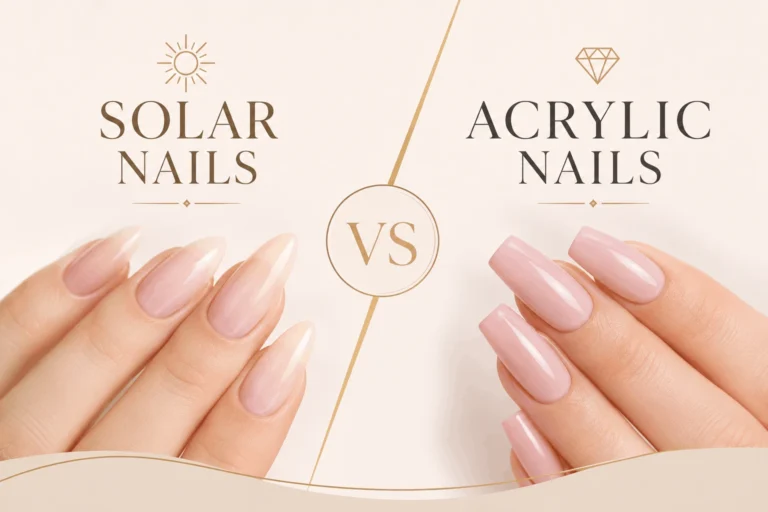
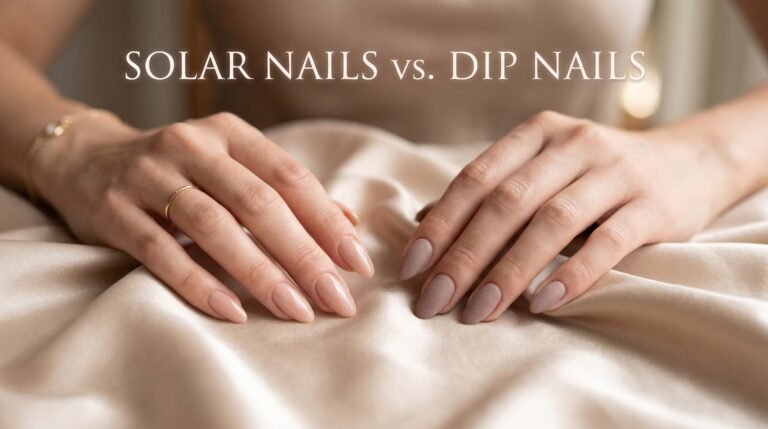
It’s 6 wins each — genuinely evenly matched. Dip wins when durability, rich colour, and annual savings matter most. Gel wins when you want a natural feel, glass-like gloss, and maximum design creativity. Still torn? Try solar nails — CND’s premium acrylic system that offers 3–5 week durability with a UV-resistant, never-yellowing gloss neither dip nor gel can match.
Explore More Nail Comparisons
Not sure yet? Browse our complete expert guides for every nail type — from solar to acrylic to press-on.